帚 (zhǒu) means "Broom." in Chinese. It has 8 strokes with the radical 巾.
Rated 3.7/5 in difficulty (challenging).
Appears in 3+ common words including 扫帚 (sào zhǒu), 帚把 (zhǒu bǎ), 用帚 (yòng zhǒu).
Due to its 8 strokes, Hanzi Writer's error detection shows 帚 requires focused practice — most learners need 10+ attempts for consistent accuracy.
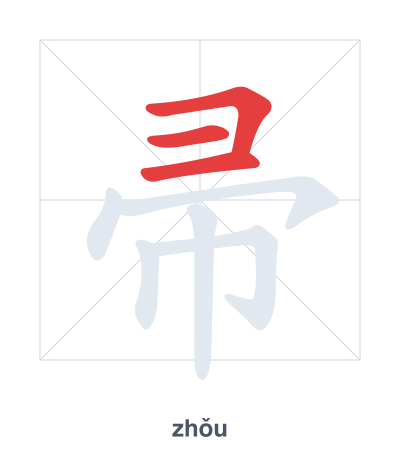
Open Hanzi Writer to see the animated stroke order and practice writing 帚 with real-time feedback.
The character 帚 (zhǒu) is written with 8 strokes. Follow the standard Chinese stroke order: top to bottom, left to right, outside before inside. The radical 巾 is one of its key components.
Practice the correct stroke order with the Hanzi Writer app to see animated stroke-by-stroke guidance with real-time feedback.
帚 means Broom..
帚 originated as a pictograph of a hand (又) holding a bundle of twigs, depicting an ancient broom. Over time, the hand simplified to 彐 and the twigs became 巾 (cloth), but the character still represents the cleaning tool.
💡 Memory Tip: Picture the top 彐 as three stiff bristles and the bottom 巾 as a cloth tied around them, forming a broom that sweeps away dirt.
墙角有一把扫帚。
qiáng jiǎo yǒu yī bǎ sào zhǒu
There is a broom in the corner.
这把帚把很轻。
zhè bǎ zhǒu bǎ hěn qīng
This broom handle is very light.
用帚把地扫干净。
yòng zhǒu bǎ dì sǎo gān jìng
Sweep the floor clean with a broom.
Open Hanzi Writer to see the animated stroke order and practice writing 帚 with real-time feedback.
✨ Animated stroke order · Handwriting recognition · HSK-graded practice · Free to use
帚 is made of two parts: the top part 彐 (a hand) and the bottom part 巾 (cloth). Together they show a hand holding a cloth bundle, which represents an ancient broom used for sweeping. The radical 巾 also hints that brooms are often made of cloth or fibers.