逖 (tì) means "Distant / Far" in Chinese. It has 10 strokes with the radical 辶.
Rated 4.2/5 in difficulty (advanced).
Appears in 3+ common words including 远逖 (yuǎn tì), 逖听 (tì tīng), 逖远 (tì yuǎn).
Due to its 10 strokes, Hanzi Writer's error detection shows 逖 requires focused practice — most learners need 10+ attempts for consistent accuracy.
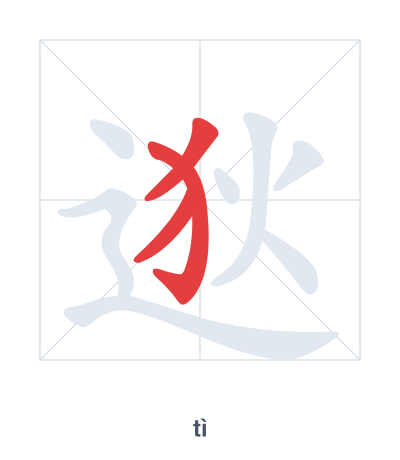
Open Hanzi Writer to see the animated stroke order and practice writing 逖 with real-time feedback.
The character 逖 (tì) is written with 10 strokes. Follow the standard Chinese stroke order: top to bottom, left to right, outside before inside. The radical 辶 is one of its key components.
Practice the correct stroke order with the Hanzi Writer app to see animated stroke-by-stroke guidance with real-time feedback.
逖 means Distant / Far.
逖 is a compound character combining the radical 辶 (walking/action) with 狄 (a northern barbarian tribe). Together, they suggest traveling far away to distant barbarian lands, hence the meaning 'distant' or 'far.'
💡 Memory Tip: Picture a dog (犭) chasing a fire (火) while you walk (辶) far, far away from the chaos.
他的名声传向远逖。
tā de míng shēng chuán xiàng yuǎn tì
His reputation spread far and wide.
我们要广为逖听。
wǒ men yào guǎng wèi tì tīng
We should listen to opinions from far and wide.
那个地方非常逖远。
nà ge dì fāng fēi cháng tì yuǎn
That place is very remote.
Open Hanzi Writer to see the animated stroke order and practice writing 逖 with real-time feedback.
✨ Animated stroke order · Handwriting recognition · HSK-graded practice · Free to use
逖 is composed of the radical 辶 (walk) on the left and 狄 (a phonetic component meaning "barbarian" or "far tribe") on the right. The radical suggests movement or travel, while 狄 hints at distant peoples, together conveying the idea of going far away.