袒 (tǎn) means "To lay bare or to shield" in Chinese. It has 10 strokes with the radical 衤.
Rated 4.2/5 in difficulty (advanced).
Appears in 3+ common words including 袒护 (tǎn hù), 袒露 (tǎn lù), 袒胸 (tǎn xiōng).
Due to its 10 strokes, Hanzi Writer's error detection shows 袒 requires focused practice — most learners need 10+ attempts for consistent accuracy.
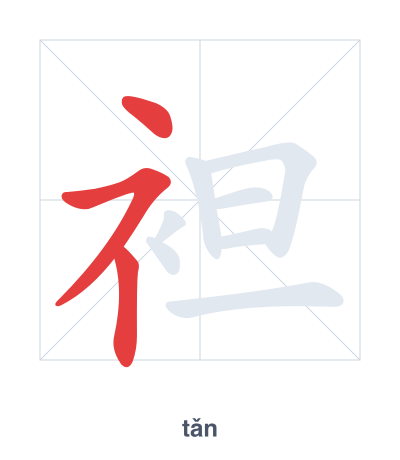
Open Hanzi Writer to see the animated stroke order and practice writing 袒 with real-time feedback.
The character 袒 (tǎn) is written with 10 strokes. Follow the standard Chinese stroke order: top to bottom, left to right, outside before inside. The radical 衤 is one of its key components.
Practice the correct stroke order with the Hanzi Writer app to see animated stroke-by-stroke guidance with real-time feedback.
袒 means To lay bare or to shield.
The character 袒 combines the clothing radical 衤 with 旦 (dawn) as a phonetic component. It originally referred to loosening or removing part of one's clothing to bare the skin, as in 袒胸露臂 (to bare one's chest and arms).
💡 Memory Tip: Picture a person at dawn (旦) stripping off their shirt (衤) to bare their chest to the morning sun.
父母不应该袒护孩子。
fù mǔ bù yīng gāi tǎn hù hái zi
Parents should not shield their children's faults.
他向朋友袒露了心声。
tā xiàng péng yǒu tǎn lù le xīn shēng
He opened up his heart to his friend.
他在海边袒胸晒太阳。
tā zài hǎi biān tǎn xiōng shài tài yáng
He is sunbathing bare-chested at the beach.
Open Hanzi Writer to see the animated stroke order and practice writing 袒 with real-time feedback.
✨ Animated stroke order · Handwriting recognition · HSK-graded practice · Free to use
The character 袒 combines the radical 衤 (clothes) on the left with 旦 (dawn) on the right. The clothes radical shows the character is related to clothing, while 旦 suggests the idea of 'baring' or 'revealing'—like the sun rising and exposing light. Together, they create the meanings of laying bare or shielding, both actions involving clothing.