崎 (qí) means "rugged; uneven" in Chinese. It has 11 strokes with the radical 山.
Rated 4.2/5 in difficulty (advanced).
Appears in 3+ common words including 崎岖 (qí qū), 崎岖不平 (qí qū bù píng), 山路崎岖 (shān lù qí qū).
Due to its 11 strokes, Hanzi Writer's error detection shows 崎 requires focused practice — most learners need 10+ attempts for consistent accuracy.
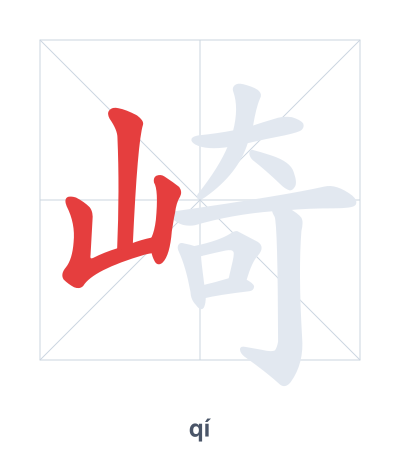
Open Hanzi Writer to see the animated stroke order and practice writing 崎 with real-time feedback.
The character 崎 (qí) is written with 11 strokes. Follow the standard Chinese stroke order: top to bottom, left to right, outside before inside. The radical 山 is one of its key components.
Practice the correct stroke order with the Hanzi Writer app to see animated stroke-by-stroke guidance with real-time feedback.
崎 means rugged; uneven.
崎 is a compound character combining the radical 山 (mountain) with 奇 (strange/odd). The mountain radical indicates terrain, while 奇 suggests something irregular or unusual, together depicting a mountain with an uneven, rugged surface.
💡 Memory Tip: Imagine a mountain (山) that looks like a strange (奇) jagged staircase leading nowhere, making every step feel rough and uneven.
这条山路很崎岖。
zhè tiáo shān lù hěn qí qū
This mountain road is very rugged.
地上的路崎岖不平。
dì shàng de lù qí qū bù píng
The road is rugged and uneven.
山路崎岖,开车要小心。
shān lù qí qū kāi chē yào xiǎo xīn
The mountain road is rugged; drive carefully.
Open Hanzi Writer to see the animated stroke order and practice writing 崎 with real-time feedback.
✨ Animated stroke order · Handwriting recognition · HSK-graded practice · Free to use
The left part is the radical 山 (mountain), which gives the character a connection to mountains or terrain. The right part is 奇 (qí, strange/odd), which contributes the sound and hints at something irregular. Together, they describe mountainous terrain that is uneven or rugged.