蜀 (shǔ) means "Shu (ancient name for Sichuan)" in Chinese. It has 13 strokes with the radical 虫.
Rated 4.2/5 in difficulty (advanced).
Appears in 3+ common words including 蜀国 (shǔ guó), 蜀道 (shǔ dào), 蜀绣 (shǔ xiù).
Due to its 13 strokes, Hanzi Writer's error detection shows 蜀 requires focused practice — most learners need 10+ attempts for consistent accuracy.
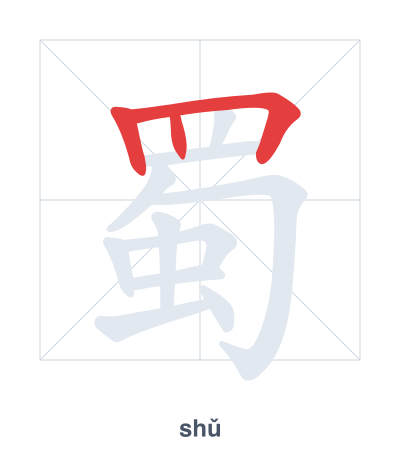
Open Hanzi Writer to see the animated stroke order and practice writing 蜀 with real-time feedback.
The character 蜀 (shǔ) is written with 13 strokes. Follow the standard Chinese stroke order: top to bottom, left to right, outside before inside. The radical 虫 is one of its key components.
Practice the correct stroke order with the Hanzi Writer app to see animated stroke-by-stroke guidance with real-time feedback.
蜀 means Shu (ancient name for Sichuan).
Originally a pictograph of a silkworm, with the top part representing its head and the bottom part 虫 (insect) its body. The character later came to denote the ancient kingdom of Shu (modern Sichuan), famed for its silk production.
💡 Memory Tip: Imagine a net (罒) trapping a fat insect (虫) – that's how the people of Shu harvested silkworms for silk.
蜀国在四川。
shǔ guó zài sì chuān
The State of Shu was located in Sichuan.
蜀道非常难走。
shǔ dào fēi cháng nán zǒu
The road to Shu is very difficult to travel.
蜀绣非常有名。
shǔ xiù fēi cháng yǒu míng
Shu embroidery is very famous.
Open Hanzi Writer to see the animated stroke order and practice writing 蜀 with real-time feedback.
✨ Animated stroke order · Handwriting recognition · HSK-graded practice · Free to use
蜀 contains the radical 虫 (chóng, meaning insect or worm) at the bottom, and a top part that looks like a net or a head. Historically, this character was used to represent the name of a region in Sichuan, and the insect radical may relate to silkworms or poisonous insects found in that area. The exact origin is debated, but the structure combines a phonetic and semantic element.