铩 (shā) means "Long spear; to moult or shed feathers" in Chinese. It has 11 strokes with the radical 钅.
Rated 4.2/5 in difficulty (advanced).
Appears in 3+ common words including 铩羽而归 (shā yǔ ér guī), 铩羽 (shā yǔ), 铩翎 (shā líng).
Due to its 11 strokes, Hanzi Writer's error detection shows 铩 requires focused practice — most learners need 10+ attempts for consistent accuracy.
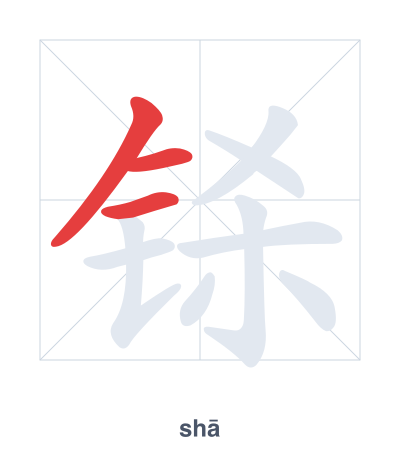
Open Hanzi Writer to see the animated stroke order and practice writing 铩 with real-time feedback.
The character 铩 (shā) is written with 11 strokes. Follow the standard Chinese stroke order: top to bottom, left to right, outside before inside. The radical 钅 is one of its key components.
Practice the correct stroke order with the Hanzi Writer app to see animated stroke-by-stroke guidance with real-time feedback.
铩 means Long spear; to moult or shed feathers.
铩 is a compound character with the radical 钅 (metal) indicating its association with weapons, and the phonetic component 杀 (shā, 'to kill') suggesting both sound and the spear's deadly purpose. The original meaning is a long, lance-like weapon; the sense 'to moult or shed' likely derives from the idea of killing off or stripping away feathers, akin to a weapon's severing action.
💡 Memory Tip: Imagine a metal-tipped spear (钅) that violently 'kills' (杀) every feather off a bird, leaving it moulting on the ground.
比赛失败后铩羽而归。
bǐ sài shī bài hòu shā yǔ ér guī
To return in dejection after losing the competition.
他的计划铩羽了。
tā de jì huà shā yǔ le
His plan failed and he suffered a setback.
鸟儿铩翎难飞。
niǎo ér shā líng nán fēi
The bird's feathers are damaged, making it hard to fly.
Open Hanzi Writer to see the animated stroke order and practice writing 铩 with real-time feedback.
✨ Animated stroke order · Handwriting recognition · HSK-graded practice · Free to use
The character 铩 combines the metal radical 钅 (jīn) on the left with 杀 (shā, meaning to kill) on the right. The metal radical relates to the meaning "long spear" (a metal weapon), while 杀 provides the pronunciation and also suggests the action of shedding or killing, which ties to the meaning "to moult or shed feathers."