钚 (bù) means "Plutonium" in Chinese. It has 9 strokes with the radical 钅.
Rated 4/5 in difficulty (challenging).
Appears in 3+ common words including 钚元素 (bù yuán sù), 金属钚 (jīn shǔ bù), 钚原子 (bù yuán zi).
Due to its 9 strokes, Hanzi Writer's error detection shows 钚 requires focused practice — most learners need 10+ attempts for consistent accuracy.
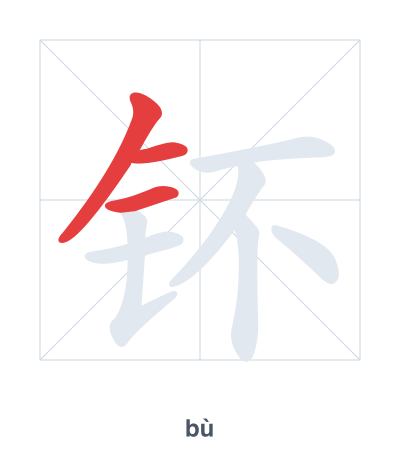
Open Hanzi Writer to see the animated stroke order and practice writing 钚 with real-time feedback.
The character 钚 (bù) is written with 9 strokes. Follow the standard Chinese stroke order: top to bottom, left to right, outside before inside. The radical 钅 is one of its key components.
Practice the correct stroke order with the Hanzi Writer app to see animated stroke-by-stroke guidance with real-time feedback.
钚 means Plutonium.
钚 is a phono-semantic compound: the radical 钅 (metal) indicates it's a metallic element, while 不 (bù) provides the pronunciation. Plutonium is a synthetic metal, so the character combines the metal radical with a phonetic component.
💡 Memory Tip: Picture the metal (钅) that is 'not' (不) found in nature—that's plutonium, created in labs.
钚元素有放射性。
bù yuán sù yǒu fàng shè xìng
Plutonium is radioactive.
金属钚非常危险。
jīn shǔ bù fēi cháng wēi xiǎn
Plutonium metal is very dangerous.
科学家在研究钚原子。
kē xué jiā zài yán jiū bù yuán zi
Scientists are studying plutonium atoms.
Open Hanzi Writer to see the animated stroke order and practice writing 钚 with real-time feedback.
✨ Animated stroke order · Handwriting recognition · HSK-graded practice · Free to use
钚 is composed of the radical 钅 (meaning metal or gold) on the left and 不 (bù, meaning "not") on the right, which gives a phonetic hint for pronunciation. The metal radical indicates that 钚 is a metallic element, specifically the radioactive metal plutonium.