穑 (sè) means "To harvest; to reap" in Chinese. It has 16 strokes with the radical 禾.
Rated 4.2/5 in difficulty (advanced).
Appears in 3+ common words including 稼穑 (jià sè), 穑事 (sè shì), 穑夫 (sè fū).
Due to its 16 strokes, Hanzi Writer's error detection shows 穑 requires focused practice — most learners need 10+ attempts for consistent accuracy.
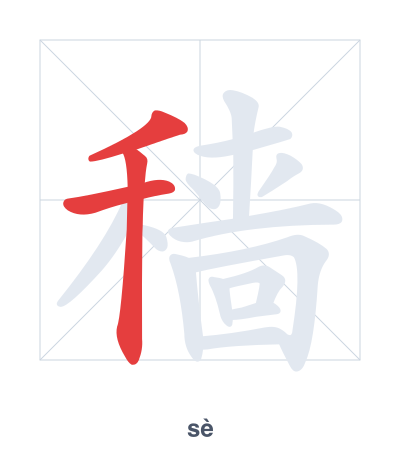
Open Hanzi Writer to see the animated stroke order and practice writing 穑 with real-time feedback.
The character 穑 (sè) is written with 16 strokes. Follow the standard Chinese stroke order: top to bottom, left to right, outside before inside. The radical 禾 is one of its key components.
Practice the correct stroke order with the Hanzi Writer app to see animated stroke-by-stroke guidance with real-time feedback.
穑 means To harvest; to reap.
The character 穑 combines the radical 禾 (grain) with 啬 (sè, originally a pictograph of grain stored in a barn, meaning 'to harvest' or 'stingy'). Together, 禾 and 啬 visually and phonetically reinforce the idea of reaping grain and storing it carefully.
💡 Memory Tip: Imagine a farmer with a big sickle (the right side 啬 looking like a curved blade) cutting through a field of grain (禾) to bring in the harvest.
农民辛苦稼穑。
nóng mín xīn kǔ jià sè
Farmers work hard at sowing and reaping.
他忙于穑事。
tā máng yú sè shì
He is busy with farming.
穑夫在田里干活。
sè fū zài tián lǐ gàn huó
The farmer is working in the field.
Open Hanzi Writer to see the animated stroke order and practice writing 穑 with real-time feedback.
✨ Animated stroke order · Handwriting recognition · HSK-graded practice · Free to use
Structurally, 穑 is composed of the radical 禾 (grain) on the left and 啬 (sè, meaning "stingy" or "to save") on the right. The 禾 radical directly connects to farming and grain, while 啬 suggests careful gathering, together forming the idea of harvesting or reaping.