稷 (jì) means "millet; God of cereals" in Chinese. It has 15 strokes with the radical 禾.
Rated 4.2/5 in difficulty (advanced).
Appears in 3+ common words including 社稷 (shè jì), 稷子 (jì zi), 后稷 (hòu jì).
Due to its 15 strokes, Hanzi Writer's error detection shows 稷 requires focused practice — most learners need 10+ attempts for consistent accuracy.
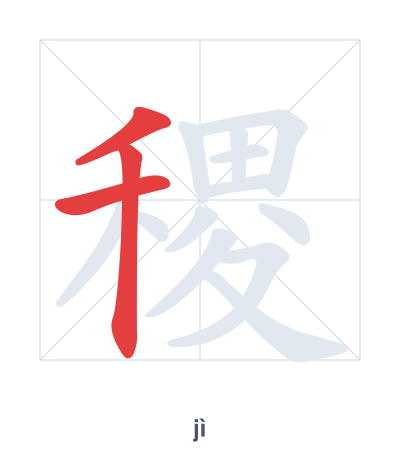
Open Hanzi Writer to see the animated stroke order and practice writing 稷 with real-time feedback.
The character 稷 (jì) is written with 15 strokes. Follow the standard Chinese stroke order: top to bottom, left to right, outside before inside. The radical 禾 is one of its key components.
Practice the correct stroke order with the Hanzi Writer app to see animated stroke-by-stroke guidance with real-time feedback.
稷 means millet; God of cereals.
稷 is a phono-semantic compound combining the grain radical 禾 on the left with 畟 (cè, meaning 'to plow') on the right, suggesting grain that is cultivated. Originally denoting a type of millet, it came to represent the god of cereals, central to ancient Chinese agriculture and state rituals.
💡 Memory Tip: Picture a farmer (right side 畟 looks like a person with arms stretched) standing proudly in a field of grain (禾), offering millet to the God of Cereals.
古人很重视社稷。
gǔ rén hěn zhòng shì shè jì
Ancient people attached great importance to the state and its altars.
稷子是一种粮食。
jì zi shì yī zhǒng liáng shí
Proso millet is a type of grain.
后稷是农业之神。
hòu jì shì nóng yè zhī shén
Houji is the god of agriculture.
Open Hanzi Writer to see the animated stroke order and practice writing 稷 with real-time feedback.
✨ Animated stroke order · Handwriting recognition · HSK-graded practice · Free to use
The character 稷 is composed of the radical 禾 (grain/plant) on the left, which directly relates to millet or crops, and the phonetic component 畟 on the right. This structure combines a meaning hint with a sound hint, as the right side gives the approximate pronunciation jì.