涩 (sè) means "Astringent / tart" in Chinese. It has 10 strokes with the radical 氵.
Rated 4.2/5 in difficulty (advanced).
Appears in 3+ common words including 苦涩 (kǔ sè), 涩味 (sè wèi), 羞涩 (xiū sè).
Due to its 10 strokes, Hanzi Writer's error detection shows 涩 requires focused practice — most learners need 10+ attempts for consistent accuracy.
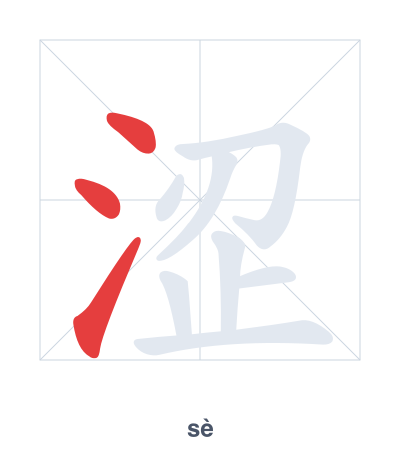
Open Hanzi Writer to see the animated stroke order and practice writing 涩 with real-time feedback.
The character 涩 (sè) is written with 10 strokes. Follow the standard Chinese stroke order: top to bottom, left to right, outside before inside. The radical 氵 is one of its key components.
Practice the correct stroke order with the Hanzi Writer app to see animated stroke-by-stroke guidance with real-time feedback.
涩 means Astringent / tart.
This character combines the water radical 氵 with 歰 (sè), which shows two feet (止) and a knife (刀) — representing friction or roughness. The original meaning refers to water that causes a puckering, rough sensation on the tongue, like an astringent taste.
💡 Memory Tip: Imagine water (氵) that makes your mouth pucker and your face change color (色) when you taste something tart.
这个药的味道很苦涩。
zhè ge yào de wèi dào hěn kǔ sè
This medicine tastes very bitter and astringent.
这种柿子有涩味。
zhè zhǒng shì zi yǒu sè wèi
This persimmon has an astringent taste.
她是一个羞涩的女孩。
tā shì yí gè xiū sè de nǚ hái
She is a shy girl.
Open Hanzi Writer to see the animated stroke order and practice writing 涩 with real-time feedback.
✨ Animated stroke order · Handwriting recognition · HSK-graded practice · Free to use
The left side is the water radical 氵, and the right side is 啬 (sè, meaning stingy). Together, water and stingy create the idea of a dry, puckering sensation in the mouth, like astringent fruit. The water radical hints at the mouth or liquid, while the right part suggests the uncomfortable tightening feeling.