搔 (sāo) means "to scratch" in Chinese. It has 12 strokes with the radical 扌.
Rated 4.2/5 in difficulty (advanced).
Appears in 3+ common words including 搔头 (sāo tóu), 搔痒 (sāo yǎng), 搔抓 (sāo zhuā).
Due to its 12 strokes, Hanzi Writer's error detection shows 搔 requires focused practice — most learners need 10+ attempts for consistent accuracy.
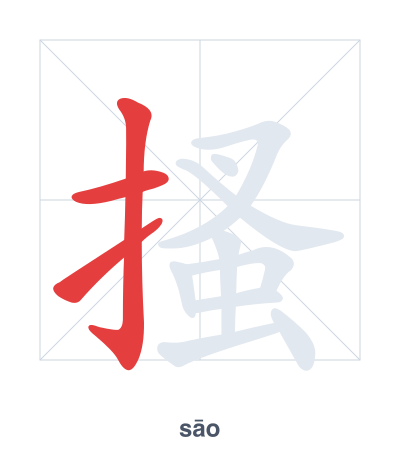
Open Hanzi Writer to see the animated stroke order and practice writing 搔 with real-time feedback.
The character 搔 (sāo) is written with 12 strokes. Follow the standard Chinese stroke order: top to bottom, left to right, outside before inside. The radical 扌 is one of its key components.
Practice the correct stroke order with the Hanzi Writer app to see animated stroke-by-stroke guidance with real-time feedback.
搔 means to scratch.
The character 搔 combines the hand radical 扌 with 蚤 (flea), depicting the action of scratching where a flea bites. The ancient form shows a hand over a flea, directly illustrating the motion of using fingers to relieve an itch caused by an insect.
💡 Memory Tip: Imagine your hand (扌) frantically scratching at a flea (蚤) that's biting your arm—that's 搔.
他不好意思地搔搔头。
tā bù hǎo yì sī dì sāo sāo tóu
He scratched his head sheepishly.
我够不着,帮我搔搔痒。
wǒ gòu bù zhe bāng wǒ sāo sāo yǎng
I can't reach it, help me scratch the itch.
皮肤过敏不要用力搔抓。
pí fū guò mǐn bú yào yòng lì sāo zhuā
Do not scratch hard if you have skin allergies.
Open Hanzi Writer to see the animated stroke order and practice writing 搔 with real-time feedback.
✨ Animated stroke order · Handwriting recognition · HSK-graded practice · Free to use
搔 is made of the radical 扌 (hand) on the left and 蚤 (flea) on the right. The hand radical indicates an action done by hand, and the flea suggests something that causes itching. Together, they show using your hand to scratch a flea bite, which is the core meaning "to scratch."