阮 (ruǎn) means "Ruan (a Chinese surname or a string instrument)." in Chinese. It has 6 strokes with the radical 阝.
Rated 2.9/5 in difficulty (moderate).
Appears in 3+ common words including 阮 (ruǎn), 中阮 (zhōng ruǎn), 阮咸 (ruǎn xián).
Hanzi Writer's stroke validation shows learners typically need 5-8 attempts to write 阮 with correct proportion and order.
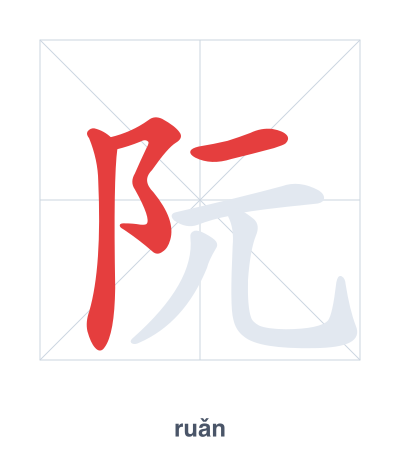
Open Hanzi Writer to see the animated stroke order and practice writing 阮 with real-time feedback.
The character 阮 (ruǎn) is written with 6 strokes. Follow the standard Chinese stroke order: top to bottom, left to right, outside before inside. The radical 阝 is one of its key components.
Practice the correct stroke order with the Hanzi Writer app to see animated stroke-by-stroke guidance with real-time feedback.
阮 means Ruan (a Chinese surname or a string instrument)..
The left side 阝 (variant of 阜) means 'mound' or 'hill', and the right side 元 means 'origin' or 'first'. Together, they suggest a hill that is a place of origin, reflecting the Ruan surname which traces back to an ancient state or clan associated with a hill.
💡 Memory Tip: Imagine a musician on a hill (阝) playing a round lute (阮) while nodding their head (元) in time with the music.
他姓阮。
tā xìng ruǎn
His surname is Ruan.
阮是一种乐器。
ruǎn shì yī zhǒng yuè qì
The Ruan is a type of musical instrument.
他会弹阮咸。
tā huì dàn ruǎn xián
He can play the ruan (a string instrument).
Open Hanzi Writer to see the animated stroke order and practice writing 阮 with real-time feedback.
✨ Animated stroke order · Handwriting recognition · HSK-graded practice · Free to use
The character 阮 is made of two parts: the left radical 阝 (from 阜, meaning hill or mound) and the right part 元 (yuán, meaning origin or first). The 阝 suggests a place name origin, while 元 provides the sound. Historically, 阮 was the name of an ancient state, and later became a surname and the name of a musical instrument.