濡 (rú) means "To moisten; to soak" in Chinese. It has 17 strokes with the radical 氵.
Rated 4.2/5 in difficulty (advanced).
Appears in 3+ common words including 濡湿 (rú shī), 濡养 (rú yǎng), 濡笔 (rú bǐ).
Due to its 17 strokes, Hanzi Writer's error detection shows 濡 requires focused practice — most learners need 10+ attempts for consistent accuracy.
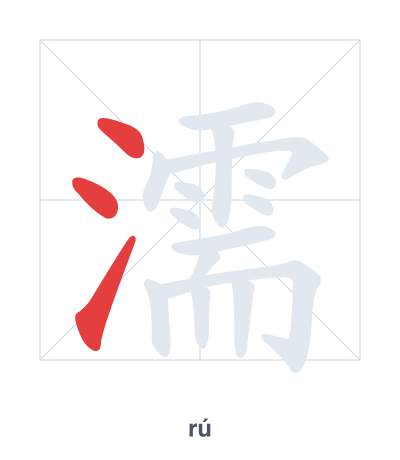
Open Hanzi Writer to see the animated stroke order and practice writing 濡 with real-time feedback.
The character 濡 (rú) is written with 17 strokes. Follow the standard Chinese stroke order: top to bottom, left to right, outside before inside. The radical 氵 is one of its key components.
Practice the correct stroke order with the Hanzi Writer app to see animated stroke-by-stroke guidance with real-time feedback.
濡 means To moisten; to soak.
濡 combines the water radical 氵 with 需 (xū), which originally pictured a person standing in the rain, indicating a need for water. Together, the character conveys the idea of being moistened or soaked by water.
💡 Memory Tip: Imagine a person in the rain (需) desperately needing water, and the water radical 氵 shows they are already drenched—soaked to the bone.
汗水濡湿了我的衬衫。
hàn shuǐ rú shī le wǒ de chèn shān
Sweat moistened my shirt.
这里的土地得到了濡养。
zhè lǐ de tǔ dì dé dào le rú yǎng
The land here has been well-nourished.
他正在濡笔写书法。
tā zhèng zài rú bǐ xiě shū fǎ
He is dipping his brush in ink to practice calligraphy.
Open Hanzi Writer to see the animated stroke order and practice writing 濡 with real-time feedback.
✨ Animated stroke order · Handwriting recognition · HSK-graded practice · Free to use
The character 濡 combines the water radical 氵 on the left with 需 on the right. The water radical directly suggests moisture or liquid, and 需 means 'to need,' so together they imply 'water that is needed' — something becoming wet or soaked. This structure clearly shows the meaning of moistening or soaking.