悫 (què) means "honest" in Chinese. It has 11 strokes with the radical 心.
Rated 4.2/5 in difficulty (advanced).
Appears in 3+ common words including 诚悫 (chéng què), 悫实 (què shí), 谨悫 (jǐn què).
Due to its 11 strokes, Hanzi Writer's error detection shows 悫 requires focused practice — most learners need 10+ attempts for consistent accuracy.
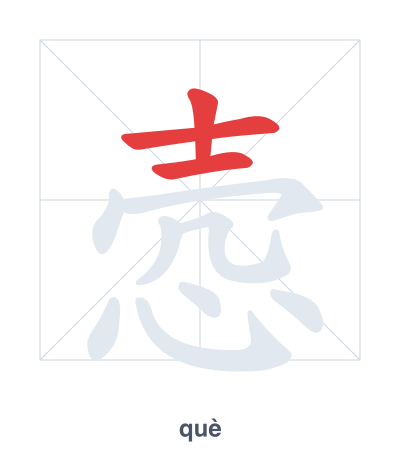
Open Hanzi Writer to see the animated stroke order and practice writing 悫 with real-time feedback.
The character 悫 (què) is written with 11 strokes. Follow the standard Chinese stroke order: top to bottom, left to right, outside before inside. The radical 心 is one of its key components.
Practice the correct stroke order with the Hanzi Writer app to see animated stroke-by-stroke guidance with real-time feedback.
悫 means honest.
悫 is a compound character where 心 (heart) serves as the meaning radical, indicating inner sincerity, and 壳 (shell) acts as the phonetic component. The shell imagery suggests a plain, unadorned exterior that matches a pure, honest heart within.
💡 Memory Tip: Picture a heart (心) tucked inside a hard shell (壳) — no pretense, just raw honesty.
他的态度很诚悫。
tā de tài dù hěn chéng què
His attitude is very honest and sincere.
这个人很悫实。
zhè ge rén hěn què shí
This person is very honest and sincere.
他做事一向谨悫。
tā zuò shì yí xiàng jǐn què
He has always been cautious and sincere in his work.
Open Hanzi Writer to see the animated stroke order and practice writing 悫 with real-time feedback.
✨ Animated stroke order · Handwriting recognition · HSK-graded practice · Free to use
悫 is composed of the radical 心 (heart/mind) on the bottom, indicating emotions or character, and the phonetic component 却 (què) on top. The heart radical suggests an inner quality, while the overall shape conveys honesty as a sincere state of mind.