绻 (quǎn) means "bound; affectionate" in Chinese. It has 11 strokes with the radical 纟.
Rated 4.2/5 in difficulty (advanced).
Appears in 3+ common words including 缱绻 (qiǎn quǎn), 绻恋 (quǎn liàn), 绻缩 (quǎn suō).
Due to its 11 strokes, Hanzi Writer's error detection shows 绻 requires focused practice — most learners need 10+ attempts for consistent accuracy.
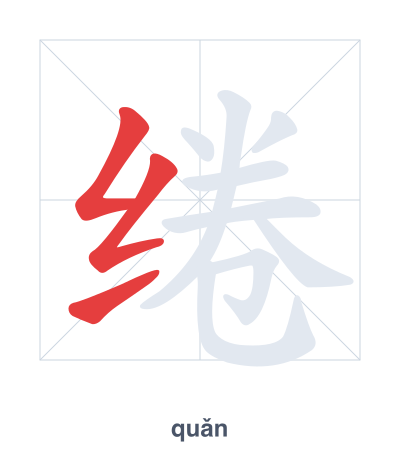
Open Hanzi Writer to see the animated stroke order and practice writing 绻 with real-time feedback.
The character 绻 (quǎn) is written with 11 strokes. Follow the standard Chinese stroke order: top to bottom, left to right, outside before inside. The radical 纟 is one of its key components.
Practice the correct stroke order with the Hanzi Writer app to see animated stroke-by-stroke guidance with real-time feedback.
绻 means bound; affectionate.
The left side 纟 (silk) indicates threads, and the right side 卷 (roll/curl) gives a phonetic hint while also suggesting the action of rolling or winding. Together, they depict silk threads being wound or bound together, which extends to the meanings of 'bound' and 'affectionate' (as in an emotional bond).
💡 Memory Tip: Imagine silk threads (纟) being tightly wrapped around a scroll (卷) to form a cozy, inseparable bundle of affection.
他们两人情意缱绻。
tā men liǎng rén qíng yì qiǎn quǎn
The two of them are deeply in love.
他对故乡十分绻恋。
tā duì gù xiāng shí fēn quǎn liàn
He is deeply attached to his hometown.
小猫绻缩在沙发上。
xiǎo māo quǎn suō zài shā fā shàng
The kitten curled up on the sofa.
Open Hanzi Writer to see the animated stroke order and practice writing 绻 with real-time feedback.
✨ Animated stroke order · Handwriting recognition · HSK-graded practice · Free to use
绻 is formed by the radical 纟 (silk) on the left and the phonetic component 卷 (quǎn, to roll) on the right. The silk radical suggests binding or tying, and 卷 adds the idea of curling or rolling, together giving the meanings of being bound together or affectionate (like being tightly connected).