堑 (qiàn) means "moat; chasm; pit" in Chinese. It has 11 strokes with the radical 土.
Rated 4.2/5 in difficulty (advanced).
Appears in 3+ common words including 吃一堑长一智 (chī yī qiàn zhǎng yī zhì), 天堑 (tiān qiàn), 壕堑 (háo qiàn).
Due to its 11 strokes, Hanzi Writer's error detection shows 堑 requires focused practice — most learners need 10+ attempts for consistent accuracy.
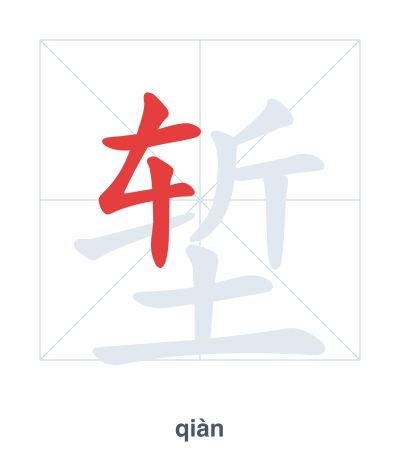
Open Hanzi Writer to see the animated stroke order and practice writing 堑 with real-time feedback.
The character 堑 (qiàn) is written with 11 strokes. Follow the standard Chinese stroke order: top to bottom, left to right, outside before inside. The radical 土 is one of its key components.
Practice the correct stroke order with the Hanzi Writer app to see animated stroke-by-stroke guidance with real-time feedback.
堑 means moat; chasm; pit.
The character 堑 combines the radical 土 (earth) with the phonetic component 斩 (zhǎn, meaning 'to cut'), together conveying an earth that has been cut—a trench or moat dug out for defense. Its ancient meaning refers to a deep pit or chasm, often used as a military barrier.
💡 Memory Tip: Picture a huge pit (土) where a giant sword (斩) has sliced open the ground, creating a dangerous chasm you can't cross.
俗话说吃一堑长一智。
sú huà shuō chī yī qiàn zhǎng yī zhì
As the saying goes, a fall into a pit, a gain in your wit.
长江是一道天然的天堑。
cháng jiāng shì yī dào tiān rán de tiān qiàn
The Yangtze River is a natural barrier.
士兵们挖好了壕堑。
shì bīng men wā hǎo le háo qiàn
The soldiers finished digging the trenches.
Open Hanzi Writer to see the animated stroke order and practice writing 堑 with real-time feedback.
✨ Animated stroke order · Handwriting recognition · HSK-graded practice · Free to use
The character 堑 is made of the radical 土 (earth) on top and the component 斩 (to cut) below. This combination suggests a "cut in the earth," which directly relates to its meanings of a moat, chasm, or pit dug into the ground.