肷 (qiǎn) means "flank (of an animal)" in Chinese. It has 8 strokes with the radical 月.
Rated 3.7/5 in difficulty (challenging).
Appears in 3+ common words including 羊肷 (yáng qiǎn), 肷皮 (qiǎn pí), 狐肷 (hú qiǎn).
Due to its 8 strokes, Hanzi Writer's error detection shows 肷 requires focused practice — most learners need 10+ attempts for consistent accuracy.
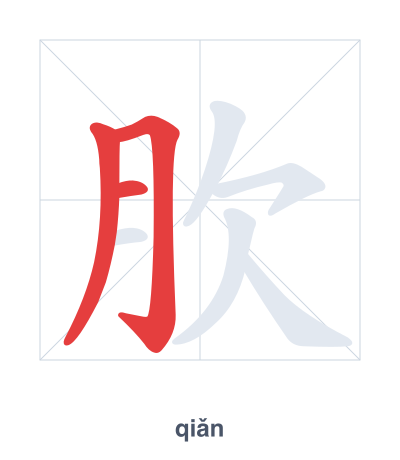
Open Hanzi Writer to see the animated stroke order and practice writing 肷 with real-time feedback.
The character 肷 (qiǎn) is written with 8 strokes. Follow the standard Chinese stroke order: top to bottom, left to right, outside before inside. The radical 月 is one of its key components.
Practice the correct stroke order with the Hanzi Writer app to see animated stroke-by-stroke guidance with real-time feedback.
肷 means flank (of an animal).
肷 is a compound character where the radical 月 (flesh/body part) indicates a part of the body, and 欠 (deficient, to lack) suggests a hollow or indented area — together they depict the flank of an animal, the softer side where the body curves inward.
💡 Memory Tip: Picture a horse's flank where a chunk of flesh (月) is missing (欠), leaving a hollow spot just behind the ribs.
羊肷肉很嫩。
yáng qiǎn ròu hěn nèn
Sheep flank meat is very tender.
这种肷皮质量很好。
zhè zhǒng qiǎn pí zhì liàng hěn hǎo
This flank fur is of very good quality.
狐肷可以做衣服。
hú qiǎn kě yǐ zuò yī fú
Fox belly fur can be used to make clothes.
Open Hanzi Writer to see the animated stroke order and practice writing 肷 with real-time feedback.
✨ Animated stroke order · Handwriting recognition · HSK-graded practice · Free to use
肷 is built from the radical 月, which means "meat" or "flesh," and the component 欠, which carries the idea of "deficiency" or "lack." Together, they suggest a fleshy area that is slightly hollow or thin, referring to the flank of an animal.