葺 (qì) means "to repair / to mend" in Chinese. It has 12 strokes with the radical 艹.
Rated 4.2/5 in difficulty (advanced).
Appears in 3+ common words including 修葺 (xiū qì), 葺理 (qì lǐ), 补葺 (bǔ qì).
Due to its 12 strokes, Hanzi Writer's error detection shows 葺 requires focused practice — most learners need 10+ attempts for consistent accuracy.
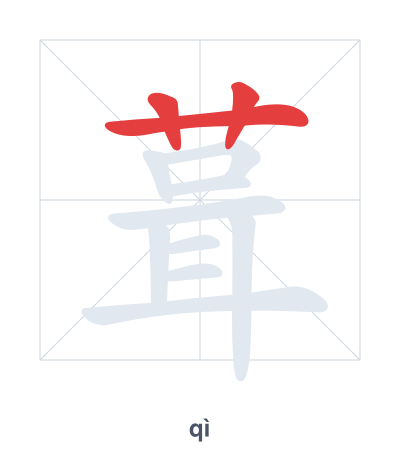
Open Hanzi Writer to see the animated stroke order and practice writing 葺 with real-time feedback.
The character 葺 (qì) is written with 12 strokes. Follow the standard Chinese stroke order: top to bottom, left to right, outside before inside. The radical 艹 is one of its key components.
Practice the correct stroke order with the Hanzi Writer app to see animated stroke-by-stroke guidance with real-time feedback.
葺 means to repair / to mend.
葺 is a phono-semantic compound: the radical 艹 (grass) symbolizes the thatching material used to repair roofs, and 咠 (qì) provides the pronunciation while also hinting at the idea of gathering or arranging. Originally meaning to re-thatch a roof, it extended to repairing and mending in general.
💡 Memory Tip: Imagine using grass (艹) to patch a leaky roof while a friend's mouth (口) yells instructions into your ear (耳) — that's repairing with 葺.
房子需要修葺。
fáng zi xū yào xiū qì
The house needs renovation.
葺理一下花园。
qì lǐ yī xià huā yuán
Tidy up the garden a bit.
补葺破旧的墙。
bǔ qì pò jiù de qiáng
Repairing the dilapidated wall.
Open Hanzi Writer to see the animated stroke order and practice writing 葺 with real-time feedback.
✨ Animated stroke order · Handwriting recognition · HSK-graded practice · Free to use
葺 is made of the radical 艹 (grass) on top and the phonetic component 咠 (qì) on the bottom. The grass radical suggests that repair work often involves natural materials like thatch, while 咠 provides the pronunciation clue.