萁 (qí) means "bean stalks" in Chinese. It has 11 strokes with the radical 艹.
Rated 4.2/5 in difficulty (advanced).
Appears in 3+ common words including 豆萁 (dòu qí), 燃萁 (rán qí), 萁草 (qí cǎo).
Due to its 11 strokes, Hanzi Writer's error detection shows 萁 requires focused practice — most learners need 10+ attempts for consistent accuracy.
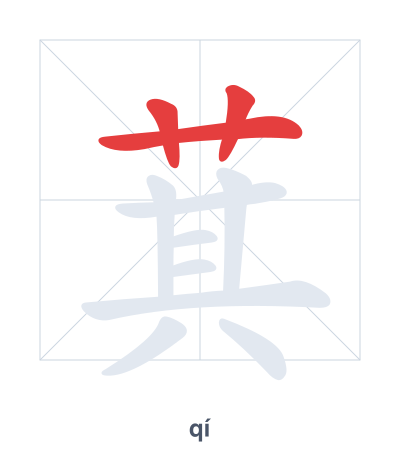
Open Hanzi Writer to see the animated stroke order and practice writing 萁 with real-time feedback.
The character 萁 (qí) is written with 11 strokes. Follow the standard Chinese stroke order: top to bottom, left to right, outside before inside. The radical 艹 is one of its key components.
Practice the correct stroke order with the Hanzi Writer app to see animated stroke-by-stroke guidance with real-time feedback.
萁 means bean stalks.
The character 萁 combines the grass radical 艹, indicating a plant, with 其 (qí) as a phonetic component. It specifically refers to the stalks of bean plants, as famously seen in the phrase '煮豆燃豆萁' (burning bean stalks to cook beans).
💡 Memory Tip: Picture a grassy field (艹) where bean stalks are stacked neatly like a small table (其).
豆萁可以烧火。
dòu qí kě yǐ shāo huǒ
Bean stalks can be used for firewood.
燃萁煮豆速度快。
rán qí zhǔ dòu sù dù kuài
Burning beanstalks to cook beans is fast.
地里长满了萁草。
dì lǐ zhǎng mǎn le qí cǎo
The field is full of beanstalks.
Open Hanzi Writer to see the animated stroke order and practice writing 萁 with real-time feedback.
✨ Animated stroke order · Handwriting recognition · HSK-graded practice · Free to use
萁 is made of the radical 艹 (grass radical) on top and the phonetic component 其 underneath. The grass radical indicates that the character is related to plants, while 其 provides the pronunciation 'qí'. Together, they form the meaning 'bean stalks', which are plant stems.