Hanzi Writer

How to Write 脐 (qí) — Meaning “navel; belly button”

10 strokes Radical: 月

脐 (qí) means "navel; belly button" in Chinese. It has 10 strokes with the radical 月.

Rated 4.2/5 in difficulty (advanced).

Appears in 3+ common words including 肚脐 (dù qí), 脐橙 (qí chéng), 脐带 (qí dài).

Due to its 10 strokes, Hanzi Writer's error detection shows 脐 requires focused practice — most learners need 10+ attempts for consistent accuracy.
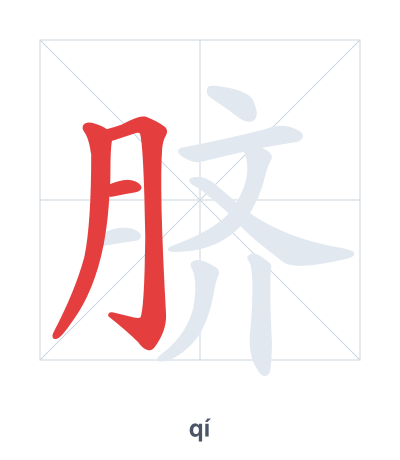
Stroke order practice for 脐 - qí

Practice Writing 脐 (qí)

Open Hanzi Writer to see the animated stroke order and practice writing 脐 with real-time feedback.

The character (qí) is written with 10 strokes. Follow the standard Chinese stroke order: top to bottom, left to right, outside before inside. The radical is one of its key components.

Practice the correct stroke order with the Hanzi Writer app to see animated stroke-by-stroke guidance with real-time feedback.

means navel; belly button.

Character
Pinyinqí (qi)
Meaningnavel; belly button
Strokes10
Radical
Difficulty4.2/5

脐 combines the flesh radical 月 (body part) with 齐 (qí, meaning 'even' or 'neat'), which provides the sound and suggests the navel's appearance as a neat scar from the umbilical cord. The character depicts a body part (月) that is an even, symmetrical mark (齐) on the abdomen.

💡 Memory Tip: Picture the moon (月) shining on a belly button that looks like a neat, even little button (齐).

dù qí
Belly button; navel.
qí chéng
navel orange
qí dài
umbilical cord

他的肚脐很深。

tā de dù qí hěn shēn

His belly button is very deep.

我喜欢吃脐橙。

wǒ xǐ huān chī qí chéng

I like eating navel oranges.

医生剪断了脐带。

yī shēng jiǎn duàn le qí dài

The doctor cut the umbilical cord.

Character Pinyin Strokes Radical
(current) 10
ruǎn 8
péng 8
fú / fù 8
Stroke order practice for 脐 - qí

Practice Writing 脐 (qí)

Open Hanzi Writer to see the animated stroke order and practice writing 脐 with real-time feedback.

✨ Animated stroke order · Handwriting recognition · HSK-graded practice · Free to use

Frequently Asked Questions about 脐

脐 consists of the radical 月 (flesh/body part) on the left and 齐 (qí, meaning even or neat) on the right. The 月 radical shows that 脐 refers to a part of the body, while 齐 provides phonetic guidance and may hint at the neat circular shape of a navel.

Characters with Radical 月

Other 10-Stroke Characters