蹼 (pǔ) means "web (of a foot)" in Chinese. It has 19 strokes with the radical 足.
Rated 4.2/5 in difficulty (advanced).
Appears in 3+ common words including 蹼泳 (pǔ yǒng), 鸭蹼 (yā pǔ), 蹼足 (pǔ zú).
Due to its 19 strokes, Hanzi Writer's error detection shows 蹼 requires focused practice — most learners need 10+ attempts for consistent accuracy.
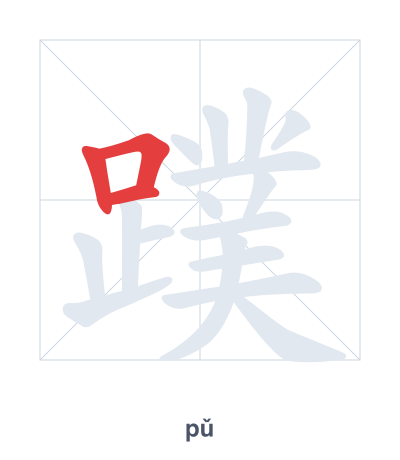
Open Hanzi Writer to see the animated stroke order and practice writing 蹼 with real-time feedback.
The character 蹼 (pǔ) is written with 19 strokes. Follow the standard Chinese stroke order: top to bottom, left to right, outside before inside. The radical 足 is one of its key components.
Practice the correct stroke order with the Hanzi Writer app to see animated stroke-by-stroke guidance with real-time feedback.
蹼 means web (of a foot).
蹼 is a phono-semantic compound. The left radical 足 (foot) indicates the meaning relates to feet, while the right component 菐 (pú) provides the pronunciation. Its meaning 'web (of a foot)' describes the webbed skin between toes of aquatic animals like ducks and frogs.
💡 Memory Tip: Imagine a duck's foot with webs like leaves (艹 on top of 菐) spreading between the toes, all attached to a 足 footprint.
他正在练习蹼泳。
tā zhèng zài liàn xí pǔ yǒng
He is practicing finswimming.
鸭蹼可以帮助鸭子游泳。
yā pǔ kě yǐ bāng zhù yā zi yóu yǒng
Webbed feet help ducks swim.
青蛙长着蹼足。
qīng wā zhǎng zhe pǔ zú
Frogs have webbed feet.
Open Hanzi Writer to see the animated stroke order and practice writing 蹼 with real-time feedback.
✨ Animated stroke order · Handwriting recognition · HSK-graded practice · Free to use
蹼 is composed of the radical 足 (foot) on the left and the phonetic component 僕 (pú, servant) on the right. The radical 足 directly links to the meaning "web of a foot," while 僕 provides the pronunciation clue. This structure shows that 蹼 refers specifically to a part of the foot.