榅 (wēn) means "quince" in Chinese. It has 13 strokes with the radical 木.
Rated 4.2/5 in difficulty (advanced).
Appears in 3+ common words including 榅桲 (wēn po), 榅桲果 (wēn po guǒ), 榅桲树 (wēn po shù).
Due to its 13 strokes, Hanzi Writer's error detection shows 榅 requires focused practice — most learners need 10+ attempts for consistent accuracy.
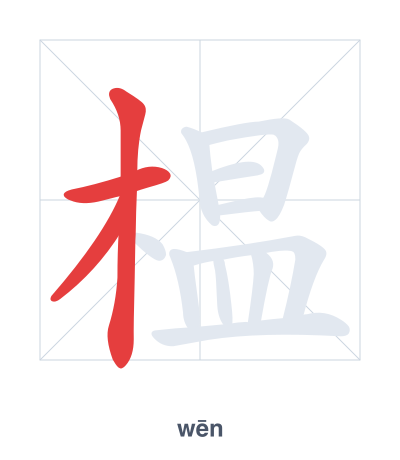
Open Hanzi Writer to see the animated stroke order and practice writing 榅 with real-time feedback.
The character 榅 (wēn) is written with 13 strokes. Follow the standard Chinese stroke order: top to bottom, left to right, outside before inside. The radical 木 is one of its key components.
Practice the correct stroke order with the Hanzi Writer app to see animated stroke-by-stroke guidance with real-time feedback.
榅 means quince.
榅 is a phono-semantic compound (形声字). The radical 木 (tree) indicates it's a type of fruit tree, while 昷 (wēn, an ancient form of 温 meaning 'warm') provides the pronunciation. The quince fruit was associated with warmth because it ripens in late autumn, requiring mild conditions.
💡 Memory Tip: Picture a quince tree (木) giving off a warm glow (昷) from its golden fruit, as if the tree itself radiates cozy autumn heat.
这种水果叫榅桲。
zhè zhǒng shuǐ guǒ jiào wēn po
This fruit is called a quince.
榅桲果的味道很香。
wēn po guǒ de wèi dào hěn xiāng
The quince fruit smells very fragrant.
园子里种了榅桲树。
yuán zi lǐ zhǒng le wēn po shù
Quince trees are planted in the garden.
Open Hanzi Writer to see the animated stroke order and practice writing 榅 with real-time feedback.
✨ Animated stroke order · Handwriting recognition · HSK-graded practice · Free to use
The character 榅 is a left-right structure. The left side 木 means 'tree', showing that this character is related to a type of tree. The right side 昷 gives the sound wēn, so together the character refers to the quince tree.