酦 (pò) means "to ferment" in Chinese. It has 12 strokes with the radical 酉.
Rated 4.2/5 in difficulty (advanced).
Appears in 3+ common words including 酦酵 (pò jiào), 酦醅 (pò pēi), 酦醅酒 (pò pēi jiǔ).
Due to its 12 strokes, Hanzi Writer's error detection shows 酦 requires focused practice — most learners need 10+ attempts for consistent accuracy.
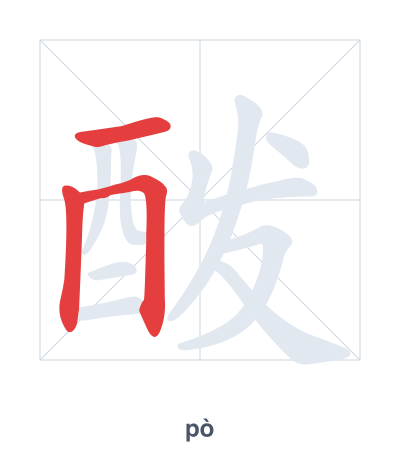
Open Hanzi Writer to see the animated stroke order and practice writing 酦 with real-time feedback.
The character 酦 (pò) is written with 12 strokes. Follow the standard Chinese stroke order: top to bottom, left to right, outside before inside. The radical 酉 is one of its key components.
Practice the correct stroke order with the Hanzi Writer app to see animated stroke-by-stroke guidance with real-time feedback.
酦 means to ferment.
酦 combines the radical 酉 (wine jar, representing liquor or fermentation) with 发 (to send out, develop), suggesting the process of 'developing' alcohol through fermentation. The right component visually indicates the release or production of gas and flavor during fermentation.
💡 Memory Tip: Picture a wine jar (酉) with a bubbling '头发' (hair-like) foam exploding out (发) as the liquid ferments.
面包正在酦酵。
miàn bāo zhèng zài pò jiào
The bread is fermenting.
这是新出的酦醅。
zhè shì xīn chū de pò pēi
This is newly brewed unstrained wine.
他喝了一口酦醅酒。
tā hē le yī kǒu pò pēi jiǔ
He took a sip of unstrained wine.
Open Hanzi Writer to see the animated stroke order and practice writing 酦 with real-time feedback.
✨ Animated stroke order · Handwriting recognition · HSK-graded practice · Free to use
The character 酦 is made of the radical 酉 (wine vessel) on the left, showing it relates to alcohol. The right side is 发 (to emit), suggesting the release of gas or change during fermentation. Together they indicate the process of fermenting wine.