叵 (pǒ) means "cannot, impossible" in Chinese. It has 5 strokes with the radical 口.
Rated 2.9/5 in difficulty (moderate).
Appears in 3+ common words including 叵测 (pǒ cè), 居心叵测 (jū xīn pǒ cè), 叵耐 (pǒ nài).
Hanzi Writer's stroke validation shows learners typically need 5-8 attempts to write 叵 with correct proportion and order.
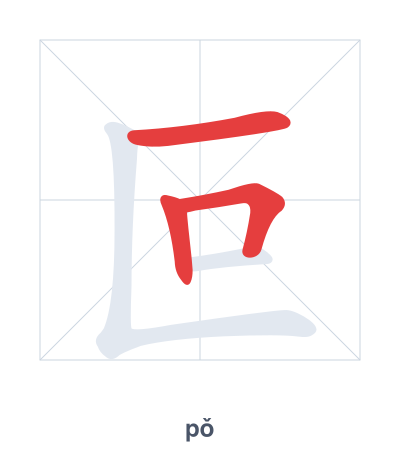
Open Hanzi Writer to see the animated stroke order and practice writing 叵 with real-time feedback.
The character 叵 (pǒ) is written with 5 strokes. Follow the standard Chinese stroke order: top to bottom, left to right, outside before inside. The radical 口 is one of its key components.
Practice the correct stroke order with the Hanzi Writer app to see animated stroke-by-stroke guidance with real-time feedback.
叵 means cannot, impossible.
叵 is the inverted form of 可 (kě, 'can'), with the top part reversed to signify the opposite meaning 'cannot'. The radical 口 (mouth) suggests speech or permission, and the inversion visually denies it, so the character represents impossibility.
💡 Memory Tip: Picture a mouth (口) with a tilted 'NO' sign blocking it, making speech or permission impossible.
人心叵测。
rén xīn pǒ cè
The human heart is unpredictable.
这个人居心叵测。
zhè ge rén jū xīn pǒ cè
This person has unpredictable and ulterior motives.
叵耐此人太无礼。
pǒ nài cǐ rén tài wú lǐ
It's unbearable that this person is so rude.
Open Hanzi Writer to see the animated stroke order and practice writing 叵 with real-time feedback.
✨ Animated stroke order · Handwriting recognition · HSK-graded practice · Free to use
The character 叵 is made of a box-like enclosure on the left and an opening on the right, but it is actually a reversed form of 可 (kě, ‘can’). The radical 口 (mouth) is inside the enclosure, and the overall shape suggests something blocked or reversed, giving the meaning ‘cannot’ or ‘impossible’.