裴 (péi) means "Pei (a Chinese surname)" in Chinese. It has 14 strokes with the radical 衣.
Rated 4.2/5 in difficulty (advanced).
Appears in 3+ common words including 裴先生 (péi xiān shēng), 姓裴 (xìng péi), 裴老师 (péi lǎo shī).
Due to its 14 strokes, Hanzi Writer's error detection shows 裴 requires focused practice — most learners need 10+ attempts for consistent accuracy.
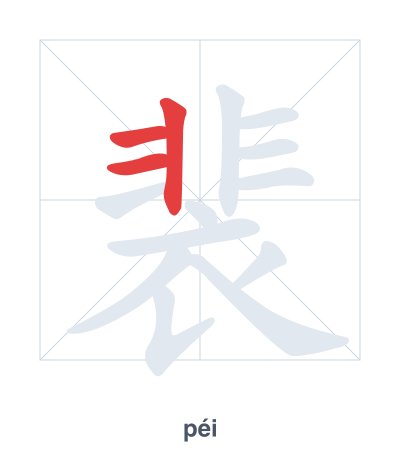
Open Hanzi Writer to see the animated stroke order and practice writing 裴 with real-time feedback.
The character 裴 (péi) is written with 14 strokes. Follow the standard Chinese stroke order: top to bottom, left to right, outside before inside. The radical 衣 is one of its key components.
Practice the correct stroke order with the Hanzi Writer app to see animated stroke-by-stroke guidance with real-time feedback.
裴 means Pei (a Chinese surname).
| Character | 裴 |
| Pinyin | péi (pei) |
| Meaning | Pei (a Chinese surname) |
| Strokes | 14 |
| Radical | 衣 |
| Difficulty | 4.2/5 |
裴 is a phono-semantic compound combining the radical 衣 (clothing) with the phonetic component 非 (fei, meaning 'not'), originally describing long, flowing robes. Over time, it became exclusively used as a Chinese surname (Pei).
💡 Memory Tip: Picture a long robe (衣) that is 'not' (非) ordinary—it's the signature look of the Pei family.
裴先生是我的老师。
péi xiān shēng shì wǒ de lǎo shī
Mr. Pei is my teacher.
我的好朋友姓裴。
wǒ de hǎo péng yǒu xìng péi
My best friend's surname is Pei.
裴老师教我们中文。
péi lǎo shī jiào wǒ men zhōng wén
Teacher Pei teaches us Chinese.
Open Hanzi Writer to see the animated stroke order and practice writing 裴 with real-time feedback.
✨ Animated stroke order · Handwriting recognition · HSK-graded practice · Free to use
裴 is composed of 非 on top and 衣 (clothing) on the bottom. Although the character is primarily a surname today, the 衣 radical suggests a possible original connection to clothing. The top part 非 provides the pronunciation (péi) through phonetic borrowing.