琶 (pá) means "Pa (second character of 'pipa')." in Chinese. It has 12 strokes with the radical 王.
Rated 3.9/5 in difficulty (challenging).
Appears in 3+ common words including 琵琶 (pí pá), 弹琵琶 (dàn pí pá), 琵琶行 (pí pá xíng).
Due to its 12 strokes, Hanzi Writer's error detection shows 琶 requires focused practice — most learners need 10+ attempts for consistent accuracy.
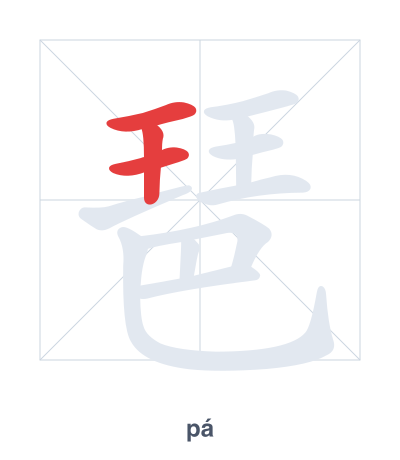
Open Hanzi Writer to see the animated stroke order and practice writing 琶 with real-time feedback.
The character 琶 (pá) is written with 12 strokes. Follow the standard Chinese stroke order: top to bottom, left to right, outside before inside. The radical 王 is one of its key components.
Practice the correct stroke order with the Hanzi Writer app to see animated stroke-by-stroke guidance with real-time feedback.
琶 means Pa (second character of 'pipa')..
琶 is a phono-semantic compound using 王 (jade, often seen in musical instruments like 琴) as a meaning hint and 巴 (bā) as a phonetic component. It was created specifically to write the second syllable of 琵琶 (pípá), the Chinese lute.
💡 Memory Tip: Picture a jade (王) serpent (巴) whose scales you pluck to produce the sound 'pa-pa'.
琵琶是乐器。
pí pá shì yuè qì
The pipa is a musical instrument.
妹妹弹琵琶。
mèi mèi dàn pí pá
My younger sister plays the pipa.
琵琶行很有名。
pí pá xíng hěn yǒu míng
The 'Song of the Pipa' is very famous.
Open Hanzi Writer to see the animated stroke order and practice writing 琶 with real-time feedback.
✨ Animated stroke order · Handwriting recognition · HSK-graded practice · Free to use
琶 is composed of the radical 王 (jade/king) on top and 巴 (bā) below. The 王 radical hints that the pipa (琵琶) is a precious or elegant instrument. The 巴 component primarily provides the pronunciation "pa" in the word pipa.