琵 (pí) means "Pi (first character of 'pipa')." in Chinese. It has 12 strokes with the radical 王.
Rated 3.9/5 in difficulty (challenging).
Appears in 3+ common words including 琵琶 (pí pá), 琵琶曲 (pí pá qū), 琵琶手 (pí pá shǒu).
Due to its 12 strokes, Hanzi Writer's error detection shows 琵 requires focused practice — most learners need 10+ attempts for consistent accuracy.
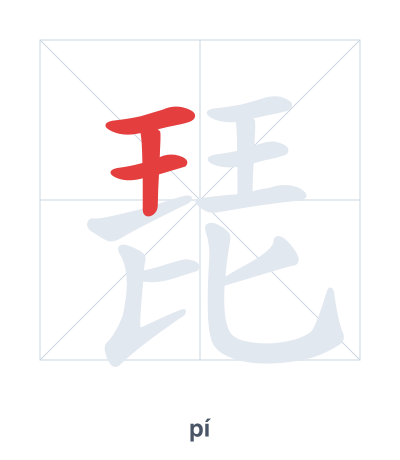
Open Hanzi Writer to see the animated stroke order and practice writing 琵 with real-time feedback.
The character 琵 (pí) is written with 12 strokes. Follow the standard Chinese stroke order: top to bottom, left to right, outside before inside. The radical 王 is one of its key components.
Practice the correct stroke order with the Hanzi Writer app to see animated stroke-by-stroke guidance with real-time feedback.
琵 means Pi (first character of 'pipa')..
琵 is a compound character where 王 (jade) suggests the precious material of the instrument, and 比 (bi) provides the sound. It appears only in the word 琵琶 (pipa), a Chinese lute, with the two characters together forming the name of this stringed instrument.
💡 Memory Tip: Picture two jade pieces (王) side by side (比) forming the body of a pipa, with strings stretched across them.
她会弹琵琶。
tā huì dàn pí pá
She can play the pipa (Chinese lute).
琵琶曲很动听。
pí pá qū hěn dòng tīng
The pipa music is very pleasant to hear.
琵琶手在表演。
pí pá shǒu zài biǎo yǎn
The pipa player is performing.
Open Hanzi Writer to see the animated stroke order and practice writing 琵 with real-time feedback.
✨ Animated stroke order · Handwriting recognition · HSK-graded practice · Free to use
琵 is made of two parts: the left side 王 (jade) and the right side 比 (compare). Together they form the sound and meaning for the first syllable of 'pipa', but 琵 by itself has no independent meaning—it only appears in the word 琵琶.