葩 (pā) means "flower / petal" in Chinese. It has 12 strokes with the radical 艹.
Rated 4.2/5 in difficulty (advanced).
Appears in 3+ common words including 奇葩 (qí pā), 奇葩说 (qí pā shuō), 奇葩事 (qí pā shì).
Due to its 12 strokes, Hanzi Writer's error detection shows 葩 requires focused practice — most learners need 10+ attempts for consistent accuracy.
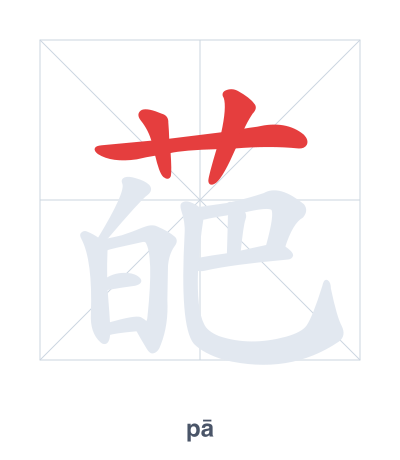
Open Hanzi Writer to see the animated stroke order and practice writing 葩 with real-time feedback.
The character 葩 (pā) is written with 12 strokes. Follow the standard Chinese stroke order: top to bottom, left to right, outside before inside. The radical 艹 is one of its key components.
Practice the correct stroke order with the Hanzi Writer app to see animated stroke-by-stroke guidance with real-time feedback.
葩 means flower / petal.
The character 葩 is a phono-semantic compound combining the grass radical (艹) with 巴 (bā) as a phonetic component. The radical indicates its connection to plants, while the whole character specifically means a flower or petal.
💡 Memory Tip: Picture a grass-covered mouth (艹 over 巴) opening like a blooming petal saying 'pā'.
他是个奇葩。
tā shì gè qí pā
He is a weirdo.
你看过奇葩说吗?
nǐ kàn guò qí pā shuō ma
Have you watched the show 'I Can I BB'?
我遇到一件奇葩事。
wǒ yù dào yī jiàn qí pā shì
I encountered something weird.
Open Hanzi Writer to see the animated stroke order and practice writing 葩 with real-time feedback.
✨ Animated stroke order · Handwriting recognition · HSK-graded practice · Free to use
葩 combines the radical 艹 (grass/plant) on top with the phonetic component 巴 (pā). The grass radical indicates it relates to plants or flowers, while 巴 provides the sound. Together, they create the meaning 'flower' or 'petal'.