垴 (nǎo) means "small hill" in Chinese. It has 9 strokes with the radical 土.
Rated 4/5 in difficulty (challenging).
Appears in 3+ common words including 山垴 (shān nǎo), 垴子 (nǎo zi), 坡垴 (pō nǎo).
Due to its 9 strokes, Hanzi Writer's error detection shows 垴 requires focused practice — most learners need 10+ attempts for consistent accuracy.
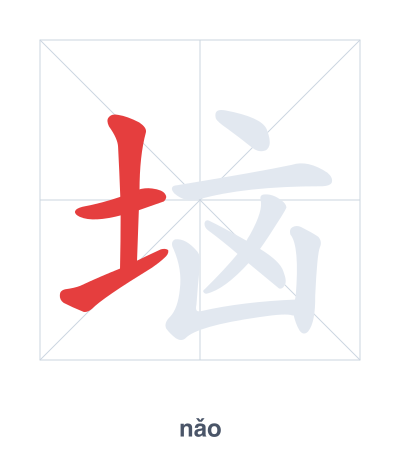
Open Hanzi Writer to see the animated stroke order and practice writing 垴 with real-time feedback.
The character 垴 (nǎo) is written with 9 strokes. Follow the standard Chinese stroke order: top to bottom, left to right, outside before inside. The radical 土 is one of its key components.
Practice the correct stroke order with the Hanzi Writer app to see animated stroke-by-stroke guidance with real-time feedback.
垴 means small hill.
垴 is a phono-semantic compound combining the radical 土 (earth, indicating landforms) with a phonetic component derived from 脑 (nǎo, brain). The character literally means 'earth-brain,' evoking a small, rounded hill that resembles the shape of a human brain.
💡 Memory Tip: Imagine a tiny hill made of dirt (土) that's actually a giant brain (脑) thinking about how small it is.
山垴上有一棵树。
shān nǎo shàng yǒu yī kē shù
There is a tree on the hilltop.
他爬上了那个垴子。
tā pá shàng le nà ge nǎo zi
He climbed up that small hill.
坡垴上开满了花。
pō nǎo shàng kāi mǎn le huā
The hilltop is covered with flowers.
Open Hanzi Writer to see the animated stroke order and practice writing 垴 with real-time feedback.
✨ Animated stroke order · Handwriting recognition · HSK-graded practice · Free to use
The character 垴 combines the radical 土 (earth, land) on the left and the component 凶 (pit) on the right. The 土 radical shows that the word relates to terrain or landforms, while 凶 visually suggests a pit or hollow, together hinting at a small hill with a depression on top. This matches the meaning 'small hill.'