猱 (náo) means "macaque or long-armed monkey" in Chinese. It has 12 strokes with the radical 犭.
Rated 4.2/5 in difficulty (advanced).
Appears in 3+ common words including 猱升 (náo shēng), 猿猱 (yuán náo), 猱杂 (náo zá).
Due to its 12 strokes, Hanzi Writer's error detection shows 猱 requires focused practice — most learners need 10+ attempts for consistent accuracy.
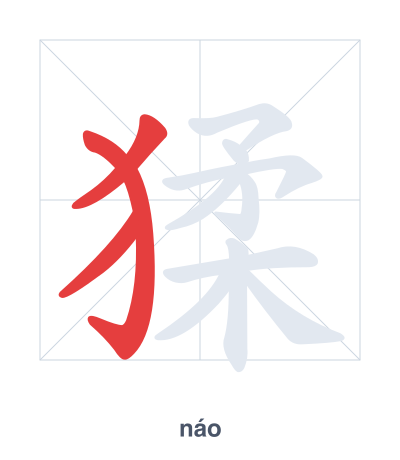
Open Hanzi Writer to see the animated stroke order and practice writing 猱 with real-time feedback.
The character 猱 (náo) is written with 12 strokes. Follow the standard Chinese stroke order: top to bottom, left to right, outside before inside. The radical 犭 is one of its key components.
Practice the correct stroke order with the Hanzi Writer app to see animated stroke-by-stroke guidance with real-time feedback.
猱 means macaque or long-armed monkey.
猱 combines the animal radical 犭 (beast) with 柔 (soft/flexible), referencing the long-armed monkey's agile and pliant limbs. The right component 柔 hints at the creature's supple movements through trees.
💡 Memory Tip: Picture a monkey (犭) stretching its long arms in a soft (柔) yoga pose to reach a banana.
他像猱升一样爬树。
tā xiàng náo shēng yī yàng pá shù
He climbed the tree as nimbly as a monkey.
山上有许多猿猱。
shān shàng yǒu xǔ duō yuán náo
There are many monkeys and gibbons on the mountain.
声音听起来很猱杂。
shēng yīn tīng qǐ lái hěn náo zá
The sound sounds very noisy and chaotic.
Open Hanzi Writer to see the animated stroke order and practice writing 猱 with real-time feedback.
✨ Animated stroke order · Handwriting recognition · HSK-graded practice · Free to use
猱 has the animal radical 犭 on the left, which shows it is a kind of animal. The right part is 柔, meaning "soft" or "flexible", hinting at the agile, flexible movements of a monkey. Together, the character represents a macaque or a long-armed monkey known for nimble climbing.