捺 (nà) means "to press down; downward stroke in calligraphy" in Chinese. It has 11 strokes with the radical 扌.
Rated 4.2/5 in difficulty (advanced).
Appears in 3+ common words including 按捺 (àn nà), 撇捺 (piē nà), 捺印 (nà yìn).
Due to its 11 strokes, Hanzi Writer's error detection shows 捺 requires focused practice — most learners need 10+ attempts for consistent accuracy.
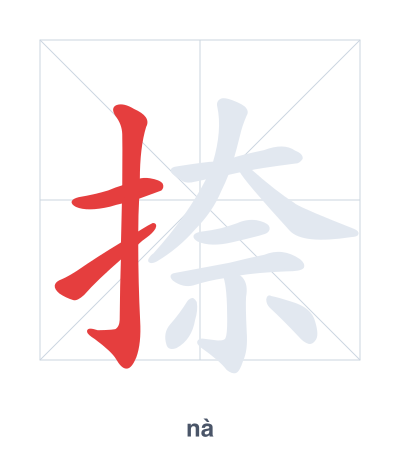
Open Hanzi Writer to see the animated stroke order and practice writing 捺 with real-time feedback.
The character 捺 (nà) is written with 11 strokes. Follow the standard Chinese stroke order: top to bottom, left to right, outside before inside. The radical 扌 is one of its key components.
Practice the correct stroke order with the Hanzi Writer app to see animated stroke-by-stroke guidance with real-time feedback.
捺 means to press down; downward stroke in calligraphy.
捺 combines the hand radical 扌 with the phonetic component 奈 (nài), originally depicting the action of pressing down with the hand. This directly relates to its meanings of 'to press down' and the downward stroke in calligraphy, where the brush is pressed firmly before lifting.
💡 Memory Tip: Picture your hand (扌) pressing down a rebellious kid (奈 sounds like 'nay') to write a perfect downward stroke.
他按捺不住喜悦。
tā àn nà bù zhù xǐ yuè
He couldn't contain his joy.
汉字有撇也有捺。
hàn zì yǒu piē yě yǒu nà
Chinese characters have left-falling and right-falling strokes.
在这里捺个手印。
zài zhè lǐ nà gè shǒu yìn
Press a fingerprint here.
Open Hanzi Writer to see the animated stroke order and practice writing 捺 with real-time feedback.
✨ Animated stroke order · Handwriting recognition · HSK-graded practice · Free to use
The left side is the radical 扌, meaning 'hand', and the right side is 奈, which gives the sound. Together, they suggest a hand performing a pressing or stamping action, which connects to the meaning 'to press down'.