摹 (mó) means "to copy" in Chinese. It has 14 strokes with the radical 手.
Rated 4.2/5 in difficulty (advanced).
Appears in 3+ common words including 临摹 (lín mó), 摹仿 (mó fǎng), 描摹 (miáo mó).
Due to its 14 strokes, Hanzi Writer's error detection shows 摹 requires focused practice — most learners need 10+ attempts for consistent accuracy.
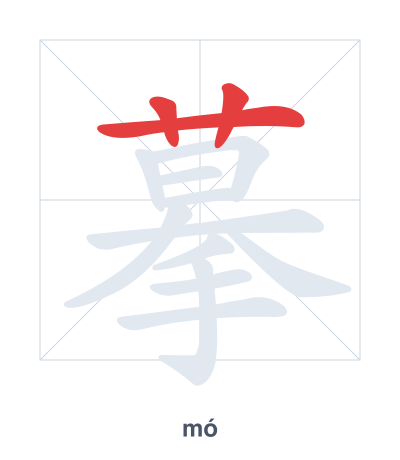
Open Hanzi Writer to see the animated stroke order and practice writing 摹 with real-time feedback.
The character 摹 (mó) is written with 14 strokes. Follow the standard Chinese stroke order: top to bottom, left to right, outside before inside. The radical 手 is one of its key components.
Practice the correct stroke order with the Hanzi Writer app to see animated stroke-by-stroke guidance with real-time feedback.
摹 means to copy.
| Character | 摹 |
| Pinyin | mó (mo) |
| Meaning | to copy |
| Strokes | 14 |
| Radical | 手 |
| Difficulty | 4.2/5 |
摹 combines the hand radical 手 with 莫, which originally depicted the sun setting in grass and now provides the pronunciation. The hand indicates the physical action of copying or tracing, as one uses their hands to replicate a pattern or image.
💡 Memory Tip: Picture a hand (手) carefully tracing a large (大) copy of the sun (日) hidden in the grass (艹).
他在临摹书法。
tā zài lín mó shū fǎ
He is practicing calligraphy by copying a model.
孩子喜欢摹仿人。
hái zi xǐ huān mó fǎng rén
Children like to imitate people.
这本书描摹风景。
zhè běn shū miáo mó fēng jǐng
This book depicts scenery.
Open Hanzi Writer to see the animated stroke order and practice writing 摹 with real-time feedback.
✨ Animated stroke order · Handwriting recognition · HSK-graded practice · Free to use
摹 is made of two parts: the top is 莫 (mò, meaning 'do not' but here acting as a sound hint) and the bottom is 手 (hand). The hand component shows that the action is done with the hand, which matches the meaning 'to copy.' Together they suggest using your hand to trace or reproduce something.