靥 (yè) means "Dimple" in Chinese. It has 15 strokes with the radical 面.
Rated 3.5/5 in difficulty (challenging).
Appears in 3+ common words including 笑靥 (xiào yè), 酒靥 (jiǔ yè), 靥辅 (yè fǔ).
Due to its 15 strokes, Hanzi Writer's error detection shows 靥 requires focused practice — most learners need 10+ attempts for consistent accuracy.
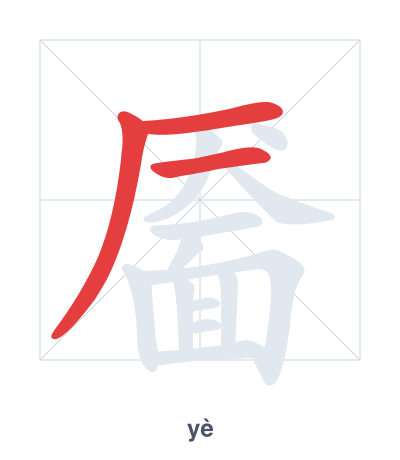
Open Hanzi Writer to see the animated stroke order and practice writing 靥 with real-time feedback.
The character 靥 (yè) is written with 15 strokes. Follow the standard Chinese stroke order: top to bottom, left to right, outside before inside. The radical 面 is one of its key components.
Practice the correct stroke order with the Hanzi Writer app to see animated stroke-by-stroke guidance with real-time feedback.
靥 means Dimple.
| Character | 靥 |
| Pinyin | yè (ye) |
| Meaning | Dimple |
| Strokes | 15 |
| Radical | 面 |
| Difficulty | 3.5/5 |
靥 combines the radical 面 (face) as a semantic component, indicating its meaning relates to the face, and 厭 (now simplified to 厌) which originally served as a phonetic hint. The character depicts a small depression or hollow on the cheek, often visualized as a 'pressing down' of the face's surface.
💡 Memory Tip: Imagine a face (面) with a little yawn (厌) that leaves a cute dimple.
她的笑靥很美。
tā de xiào yè hěn měi
Her dimpled smile is very beautiful.
他脸上有个小酒靥。
tā liǎn shàng yǒu gè xiǎo jiǔ yè
He has a small dimple on his face.
她的靥辅若隐若现。
tā de yè fǔ ruò yǐn ruò xiàn
Her dimples are faintly visible.
Open Hanzi Writer to see the animated stroke order and practice writing 靥 with real-time feedback.
✨ Animated stroke order · Handwriting recognition · HSK-graded practice · Free to use
靥 is composed of two parts: the left side is 面 (miàn, face) and the right side is 厌 (yàn, to dislike). The 面 part gives the meaning of 'face,' and the 厌 part provides the sound yè, so together it means a small depression on the face — a dimple.