娩 (miǎn) means "to give birth; delivery" in Chinese. It has 10 strokes with the radical 女.
Rated 4.2/5 in difficulty (advanced).
Appears in 3+ common words including 分娩 (fēn miǎn), 娩出 (miǎn chū), 顺娩 (shùn miǎn).
Due to its 10 strokes, Hanzi Writer's error detection shows 娩 requires focused practice — most learners need 10+ attempts for consistent accuracy.
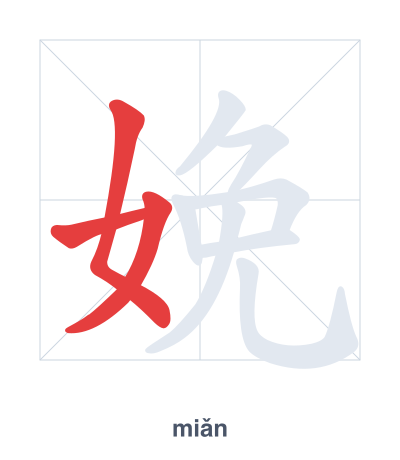
Open Hanzi Writer to see the animated stroke order and practice writing 娩 with real-time feedback.
The character 娩 (miǎn) is written with 10 strokes. Follow the standard Chinese stroke order: top to bottom, left to right, outside before inside. The radical 女 is one of its key components.
Practice the correct stroke order with the Hanzi Writer app to see animated stroke-by-stroke guidance with real-time feedback.
娩 means to give birth; delivery.
This character combines the radical 女 (woman) with 免 (miǎn), which provides the sound. The meaning 'to give birth' comes from the image of a woman in labor, with 免 also hinting at the 'delivery' or release of the baby.
💡 Memory Tip: Picture a woman (女) in labor, and the baby 'avoids' staying inside any longer (免) – it's time to be born!
她正在医院分娩。
tā zhèng zài yī yuàn fēn miǎn
She is giving birth in the hospital.
婴儿顺利娩出了。
yīng ér shùn lì miǎn chū le
The baby was delivered successfully.
她选择了顺娩。
tā xuǎn zé le shùn miǎn
She chose natural childbirth.
Open Hanzi Writer to see the animated stroke order and practice writing 娩 with real-time feedback.
✨ Animated stroke order · Handwriting recognition · HSK-graded practice · Free to use
娩 is composed of the radical 女 (woman) on the left, which indicates the character relates to women or female activities. On the right is 免 (miǎn), which contributes the sound and also suggests 'to avoid' or 'to release,' together hinting at the process of delivering a baby. So the structure combines 'woman' with 'release' to mean giving birth.