瞇 (mī) means "To squint" in Chinese. It has 14 strokes with the radical 目.
Rated 4.2/5 in difficulty (advanced).
Appears in 3+ common words including 瞇眼 (mī yǎn), 瞇一会 (mī yī huì), 笑瞇瞇 (xiào mī mī).
Due to its 14 strokes, Hanzi Writer's error detection shows 瞇 requires focused practice — most learners need 10+ attempts for consistent accuracy.
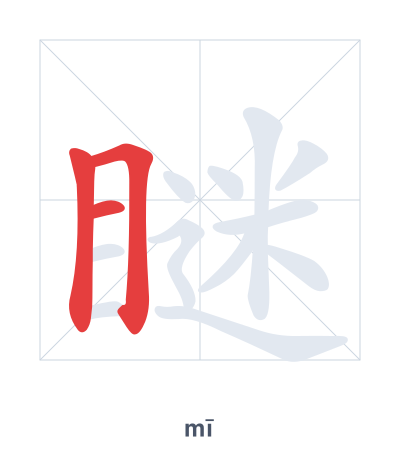
Open Hanzi Writer to see the animated stroke order and practice writing 瞇 with real-time feedback.
The character 瞇 (mī) is written with 14 strokes. Follow the standard Chinese stroke order: top to bottom, left to right, outside before inside. The radical 目 is one of its key components.
Practice the correct stroke order with the Hanzi Writer app to see animated stroke-by-stroke guidance with real-time feedback.
瞇 means To squint.
This character combines the eye radical 目 with 迷 (mí, meaning 'to confuse' or 'lost'), suggesting that squinting occurs when vision is unclear or confusing. The right side also provides a phonetic clue for the pronunciation mī.
💡 Memory Tip: When you squint, your eyes (目) become narrow slits, and you feel lost (迷) in the blurry world around you.
他瞇著眼睛看书。
tā mī zhù yǎn jīng kàn shū
He squinted his eyes to read the book.
我想去瞇一会。
wǒ xiǎng qù mī yī huì
I want to go take a nap.
她笑瞇瞇地看著我。
tā xiào mī mī dì kàn zhù wǒ
She looked at me with a beaming smile.
Open Hanzi Writer to see the animated stroke order and practice writing 瞇 with real-time feedback.
✨ Animated stroke order · Handwriting recognition · HSK-graded practice · Free to use
The left side is the radical 目, meaning 'eye', and the right side is 米, meaning 'rice'. Squinting narrows the eyes into small slits like grains of rice, so the character visually suggests eyes becoming rice-shaped.