Hanzi Writer

How to Write 懑 (mèn) — Meaning “resentful; depressed”

mèn 17 strokes Radical: 心

懑 (mèn) means "resentful; depressed" in Chinese. It has 17 strokes with the radical 心.

Rated 4.2/5 in difficulty (advanced).

Appears in 3+ common words including 愤懑 (fèn mèn), 烦懑 (fán mèn), 郁懑 (yù mèn).

Due to its 17 strokes, Hanzi Writer's error detection shows 懑 requires focused practice — most learners need 10+ attempts for consistent accuracy.
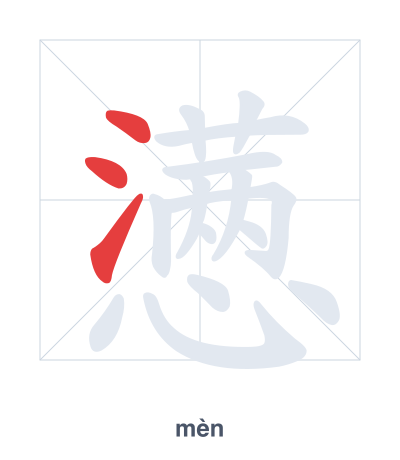
Stroke order practice for 懑 - mèn

Practice Writing 懑 (mèn)

Open Hanzi Writer to see the animated stroke order and practice writing 懑 with real-time feedback.

The character (mèn) is written with 17 strokes. Follow the standard Chinese stroke order: top to bottom, left to right, outside before inside. The radical is one of its key components.

Practice the correct stroke order with the Hanzi Writer app to see animated stroke-by-stroke guidance with real-time feedback.

means resentful; depressed.

Character
Pinyinmèn (men)
Meaningresentful; depressed
Strokes17
Radical
Difficulty4.2/5

The character 懑 combines 满 (mǎn, meaning 'full') and 心 (xīn, 'heart'), suggesting a heart filled to overflowing with pent-up emotions like resentment or depression. The top component 满 itself contains water radical 氵, implying a flood of feelings that cannot be released.

💡 Memory Tip: Picture your heart (心) stuffed so full (满) of grudges that it feels like a swollen, heavy lump pressing down on your chest—that's 懑.

fèn mèn
Resentful; aggrieved.
fán mèn
Depressed and annoyed
yù mèn
depressed and resentful

他感到十分愤懑。

tā gǎn dào shí fēn fèn mèn

He felt very resentful.

心中有些烦懑。

xīn zhōng yǒu xiē fán mèn

Feeling somewhat annoyed and depressed.

他的心情很郁懑。

tā de xīn qíng hěn yù mèn

He feels very depressed.

Character Pinyin Strokes Radical
(current) mèn 17
huì 15
wèi 15
biē 15
Stroke order practice for 懑 - mèn

Practice Writing 懑 (mèn)

Open Hanzi Writer to see the animated stroke order and practice writing 懑 with real-time feedback.

✨ Animated stroke order · Handwriting recognition · HSK-graded practice · Free to use

Frequently Asked Questions about 懑

懑 is composed of the radical 心 (heart) at the bottom, which relates to emotions, and the upper part 满 (mǎn, full) minus the water radical, acting as a phonetic component. This suggests a heart that is "full" of negative feelings, like resentment or depression.

Characters with Radical 心

Other 17-Stroke Characters