抡 (lūn) means "to swing; to brandish" in Chinese. It has 7 strokes with the radical 扌, and is HSK Level 7.
Rated 3.5/5 in difficulty (challenging).
Harder than 18% of HSK Level 7 characters.
Appears in 3+ common words including 抡起 (lūn qǐ), 抡动 (lūn dòng), 抡胳膊 (lūn gē bó).
Due to its 7 strokes, Hanzi Writer's error detection shows 抡 requires focused practice — most learners need 10+ attempts for consistent accuracy.
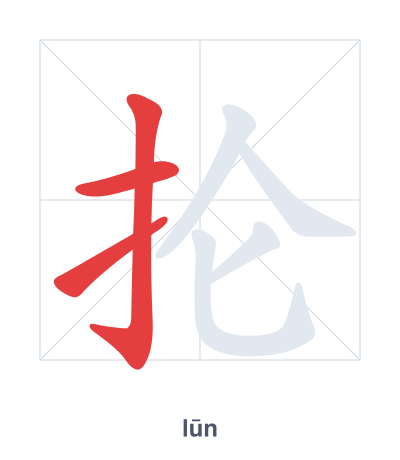
Open Hanzi Writer to see the animated stroke order and practice writing 抡 with real-time feedback.
The character 抡 (lūn) is written with 7 strokes. Follow the standard Chinese stroke order: top to bottom, left to right, outside before inside. The radical 扌 is one of its key components.
Practice the correct stroke order with the Hanzi Writer app to see animated stroke-by-stroke guidance with real-time feedback.
抡 means to swing; to brandish.
As an HSK Level 7 character, 抡 is an intermediate-level character.
抡 is a phono-semantic compound where the radical 扌 represents a hand, and the phonetic component 仑 provides the sound 'lún'. The hand radical conveys the action of swinging or brandishing an object.
💡 Memory Tip: Picture a hand (扌) grabbing a round wheel (仑, resembling a circle) and swinging it around.
他抡起拳头打过去。
tā lūn qǐ quán tou dǎ guò qù
He swung his fist and struck.
他在抡动大锤。
tā zài lūn dòng dà chuí
He is swinging a sledgehammer.
跑步时要抡胳膊。
pǎo bù shí yào lūn gē bó
Swing your arms when running.
Open Hanzi Writer to see the animated stroke order and practice writing 抡 with real-time feedback.
✨ Animated stroke order · Handwriting recognition · HSK-graded practice · Free to use
The left side is the radical 扌 (hand), indicating the action uses the hand or arm. The right side is 仑 (lún), which gives the pronunciation hint. Together, the character means using your hand to swing or brandish something.