胪 (lú) means "to state; to list" in Chinese. It has 9 strokes with the radical 月.
Rated 4/5 in difficulty (challenging).
Appears in 3+ common words including 胪列 (lú liè), 传胪 (chuán lú), 胸胪 (xiōng lú).
Due to its 9 strokes, Hanzi Writer's error detection shows 胪 requires focused practice — most learners need 10+ attempts for consistent accuracy.
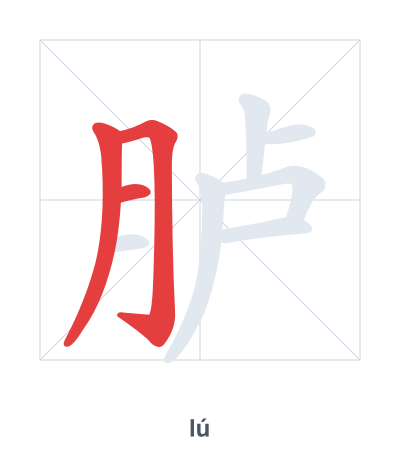
Open Hanzi Writer to see the animated stroke order and practice writing 胪 with real-time feedback.
The character 胪 (lú) is written with 9 strokes. Follow the standard Chinese stroke order: top to bottom, left to right, outside before inside. The radical 月 is one of its key components.
Practice the correct stroke order with the Hanzi Writer app to see animated stroke-by-stroke guidance with real-time feedback.
胪 means to state; to list.
胪 is a phono-semantic compound with the radical 月 (flesh/body) and the phonetic component 卢 (lú). Originally it referred to the skin or belly, but in classical Chinese it was borrowed to mean 'to state in order' or 'to list', often used in official announcements.
💡 Memory Tip: Imagine a belly (月) that is like a list-making machine inside a hut (卢), stating each item it digests.
请胪列你的理由。
qǐng lú liè nǐ de lǐ yóu
Please list your reasons.
他在传胪中榜了。
tā zài chuán lú zhōng bǎng le
He passed the imperial examination.
他的胸胪很宽阔。
tā de xiōng lú hěn kuān kuò
His chest is very broad.
Open Hanzi Writer to see the animated stroke order and practice writing 胪 with real-time feedback.
✨ Animated stroke order · Handwriting recognition · HSK-graded practice · Free to use
The character 胪 is composed of the radical 月 (meat/flesh) on the left and the phonetic component 卢 (lú) on the right. The 月 radical indicates a connection to the body, which relates to the original meaning "chest" or "belly region" (seen in the word 胸胪). The right side provides the sound but also hints at the extended meaning of "to list" or "to state" through its use in ancient court announcements.