燎 (liáo) means "To singe / To burn" in Chinese. It has 16 strokes with the radical 火.
Rated 4.2/5 in difficulty (advanced).
Appears in 3+ common words including 燎原 (liáo yuán), 燎泡 (liáo pào), 熏燎 (xūn liáo).
Due to its 16 strokes, Hanzi Writer's error detection shows 燎 requires focused practice — most learners need 10+ attempts for consistent accuracy.
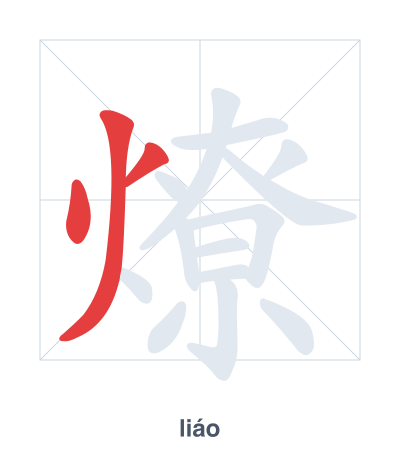
Open Hanzi Writer to see the animated stroke order and practice writing 燎 with real-time feedback.
The character 燎 (liáo) is written with 16 strokes. Follow the standard Chinese stroke order: top to bottom, left to right, outside before inside. The radical 火 is one of its key components.
Practice the correct stroke order with the Hanzi Writer app to see animated stroke-by-stroke guidance with real-time feedback.
燎 means To singe / To burn.
燎 combines the fire radical 火 with 尞, an ancient pictograph of a wooden structure or pile of sticks ablaze, emphasizing the act of burning or singeing. The left side shows fire, while the right side 尞 reinforces the fiery destruction.
💡 Memory Tip: Imagine a blazing fire (火) engulfing a pile of long sticks (尞) until they are thoroughly singed and smoking.
星星之火可以燎原。
xīng xīng zhī huǒ kě yǐ liáo yuán
A single spark can start a prairie fire.
他的手起了个燎泡。
tā de shǒu qǐ le gè liáo pào
He got a blister on his hand.
墙被烟熏燎黑了。
qiáng bèi yān xūn liáo hēi le
The wall was scorched black by smoke.
Open Hanzi Writer to see the animated stroke order and practice writing 燎 with real-time feedback.
✨ Animated stroke order · Handwriting recognition · HSK-graded practice · Free to use
燎 is made of the radical 火 (fire) on the left and the component 尞 on the right. The 火 radical directly links to burning, while 尞 originally carried the idea of fuel or a firebrand, together meaning "to singe" or "to burn."