蔹 (liǎn) means "ampelopsis (a type of vine)" in Chinese. It has 14 strokes with the radical 艹.
Rated 4.2/5 in difficulty (advanced).
Appears in 3+ common words including 白蔹 (bái liǎn), 蔹草 (liǎn cǎo), 蔹蔓 (liǎn màn).
Due to its 14 strokes, Hanzi Writer's error detection shows 蔹 requires focused practice — most learners need 10+ attempts for consistent accuracy.
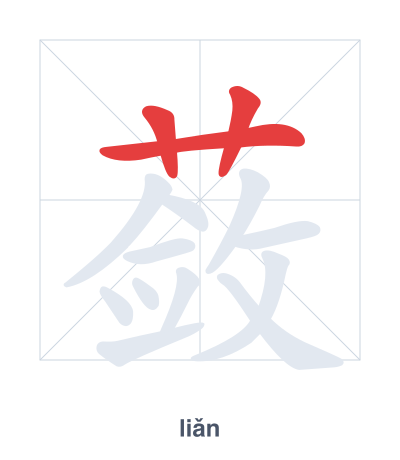
Open Hanzi Writer to see the animated stroke order and practice writing 蔹 with real-time feedback.
The character 蔹 (liǎn) is written with 14 strokes. Follow the standard Chinese stroke order: top to bottom, left to right, outside before inside. The radical 艹 is one of its key components.
Practice the correct stroke order with the Hanzi Writer app to see animated stroke-by-stroke guidance with real-time feedback.
蔹 means ampelopsis (a type of vine).
蔹 is a compound character with the grass radical 艹 indicating it's a plant, and the phonetic component 敛 (liǎn, meaning 'to gather or collect') suggesting its nature as a climbing vine that gathers onto walls or trellises. The character visually represents a plant that 'collects' itself as it grows upward.
💡 Memory Tip: Imagine a creeping vine with green leaves (艹) that 'gathers' (敛) itself tightly around a trellis, forming a dense green curtain.
白蔹是一种中药。
bái liǎn shì yī zhǒng zhōng yào
Ampelopsis japonica is a type of Chinese medicine.
墙角长了蔹草。
qiáng jiǎo zhǎng le liǎn cǎo
Wild grapes are growing in the corner.
蔹蔓爬上了树。
liǎn màn pá shàng le shù
The vines climbed up the tree.
Open Hanzi Writer to see the animated stroke order and practice writing 蔹 with real-time feedback.
✨ Animated stroke order · Handwriting recognition · HSK-graded practice · Free to use
蔹 is composed of the radical 艹 (grass/plant) on top and 敛 (liǎn, meaning 'to gather') below. The radical indicates it is a type of plant, while the phonetic component 敛 hints at the pronunciation 'liǎn'. Together, they form the name of a vine-like herb used in traditional Chinese medicine.