跞 (lì) means "to move" in Chinese. It has 12 strokes with the radical 足.
Rated 4.2/5 in difficulty (advanced).
Appears in 3+ common words including 卓跞 (zhuó lì), 跞动 (lì dòng), 跞跞 (lì lì).
Due to its 12 strokes, Hanzi Writer's error detection shows 跞 requires focused practice — most learners need 10+ attempts for consistent accuracy.
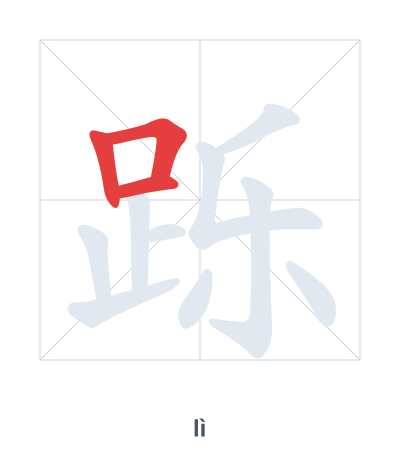
Open Hanzi Writer to see the animated stroke order and practice writing 跞 with real-time feedback.
The character 跞 (lì) is written with 12 strokes. Follow the standard Chinese stroke order: top to bottom, left to right, outside before inside. The radical 足 is one of its key components.
Practice the correct stroke order with the Hanzi Writer app to see animated stroke-by-stroke guidance with real-time feedback.
跞 means to move.
跞 is a phono-semantic compound character. The left radical 足 (foot) indicates that the meaning relates to foot movement, while the right component 乐 (lè/yuè, 'music') provides the sound and suggests a lively, rhythmic action. Together, the character evokes the idea of moving or stepping, as if dancing to music.
💡 Memory Tip: Picture a musical note (乐) attached to a dancing foot (足), stepping lively to the beat.
他的才华非常卓跞。
tā de cái huá fēi cháng zhuó lì
His talent is very remarkable.
树影在墙上跞动。
shù yǐng zài qiáng shàng lì dòng
The tree shadows are flickering on the wall.
他的表现很跞跞。
tā de biǎo xiàn hěn lì lì
His performance was brilliant.
Open Hanzi Writer to see the animated stroke order and practice writing 跞 with real-time feedback.
✨ Animated stroke order · Handwriting recognition · HSK-graded practice · Free to use
跞 is composed of the radical 足 (foot) on the left and the phonetic component 乐 (music/joy) on the right. The foot radical indicates movement or action, so the character means 'to move'. The right part provides a hint for pronunciation but does not directly affect meaning.