荔 (lì) means "Lychee" in Chinese. It has 9 strokes with the radical 艹.
Rated 4/5 in difficulty (challenging).
Appears in 3+ common words including 荔枝 (lì zhī), 荔枝干 (lì zhī gàn), 荔枝肉 (lì zhī ròu).
Due to its 9 strokes, Hanzi Writer's error detection shows 荔 requires focused practice — most learners need 10+ attempts for consistent accuracy.
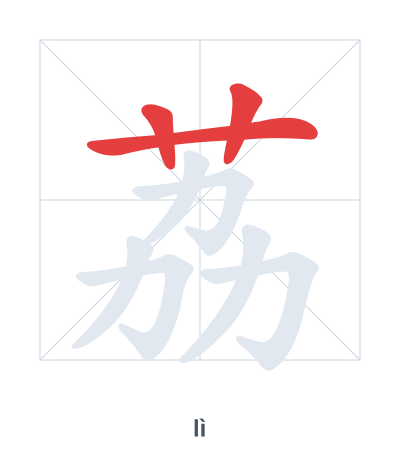
Open Hanzi Writer to see the animated stroke order and practice writing 荔 with real-time feedback.
The character 荔 (lì) is written with 9 strokes. Follow the standard Chinese stroke order: top to bottom, left to right, outside before inside. The radical 艹 is one of its key components.
Practice the correct stroke order with the Hanzi Writer app to see animated stroke-by-stroke guidance with real-time feedback.
荔 means Lychee.
荔 is a phono-semantic compound: the radical 艹 (grass/plant) indicates it is a type of plant, while 劦 (xié) provides the phonetic cue for the pronunciation lì. The character originally depicted the lychee tree, which bears clusters of rough-skinned fruit.
💡 Memory Tip: Picture three strong men (三个力) standing under a plant (艹) and using all their strength to peel open a spiky lychee.
夏天的荔枝很好吃。
xià tiān de lì zhī hěn hǎo chī
Lychees in summer are delicious.
奶奶喜欢吃荔枝干。
nǎi nǎi xǐ huān chī lì zhī gàn
Grandma likes eating dried lychees.
这道菜叫荔枝肉。
zhè dào cài jiào lì zhī ròu
This dish is called Lychee Pork.
Open Hanzi Writer to see the animated stroke order and practice writing 荔 with real-time feedback.
✨ Animated stroke order · Handwriting recognition · HSK-graded practice · Free to use
The character 荔 consists of the grass radical 艹 on top, indicating it is a plant, and the phonetic component 劦 (lì) below, which hints at the pronunciation. Together they represent the lychee fruit, which grows on a tropical tree. The grass radical tells the reader that 荔 refers to a type of plant or fruit.