脷 (lì) means "tongue (Cantonese/dialect)" in Chinese. It has 11 strokes with the radical 月.
Rated 4.2/5 in difficulty (advanced).
Appears in 3+ common words including 猪脷 (zhū lì), 牛脷 (niú lì), 脷尖 (lì jiān).
Due to its 11 strokes, Hanzi Writer's error detection shows 脷 requires focused practice — most learners need 10+ attempts for consistent accuracy.
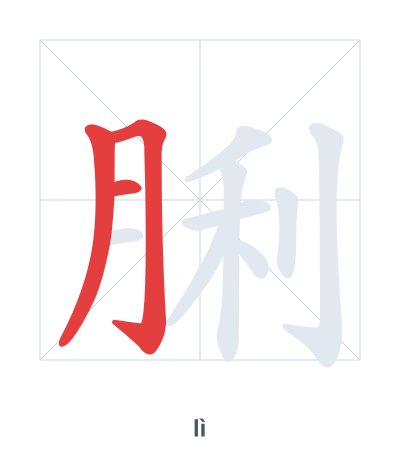
Open Hanzi Writer to see the animated stroke order and practice writing 脷 with real-time feedback.
The character 脷 (lì) is written with 11 strokes. Follow the standard Chinese stroke order: top to bottom, left to right, outside before inside. The radical 月 is one of its key components.
Practice the correct stroke order with the Hanzi Writer app to see animated stroke-by-stroke guidance with real-time feedback.
脷 means tongue (Cantonese/dialect).
脷 is a compound character with the radical 月 (meat/flesh) indicating a body part and the phonetic component 利 (lì, meaning 'sharp' or 'benefit'). Together, they suggest the tongue as a fleshy organ that can be sharp in speech, and the character was specifically formed for Cantonese where it replaced the standard 舌 for 'tongue'.
💡 Memory Tip: Picture a sharp knife (利) slicing a piece of meat (月), and you use your tongue to taste the sharp flavor—that's 脷 (tongue)!
妈妈买了猪脷。
mā mā mǎi le zhū lì
Mom bought pig tongue.
牛脷的味道很好。
niú lì de wèi dào hěn hǎo
Ox tongue tastes very good.
脷尖感觉有点麻。
lì jiān gǎn jué yǒu diǎn má
The tip of the tongue feels a bit numb.
Open Hanzi Writer to see the animated stroke order and practice writing 脷 with real-time feedback.
✨ Animated stroke order · Handwriting recognition · HSK-graded practice · Free to use
The character 脷 is made of two parts: the left side 月 (the meat radical) and the right side 利 (lì, meaning sharp or profit). The 月 radical indicates that 脷 refers to a body part, specifically the tongue. The right side 利 gives the pronunciation and may also hint at the tongue's sharp or agile nature.