饹 (le) means "Ge (used in the word 'Hele')" in Chinese. It has 9 strokes with the radical 饣.
Rated 4/5 in difficulty (challenging).
Appears in 3+ common words including 饸饹 (hé le), 饸饹面 (hé le miàn), 压饸饹 (yā hé le).
Due to its 9 strokes, Hanzi Writer's error detection shows 饹 requires focused practice — most learners need 10+ attempts for consistent accuracy.
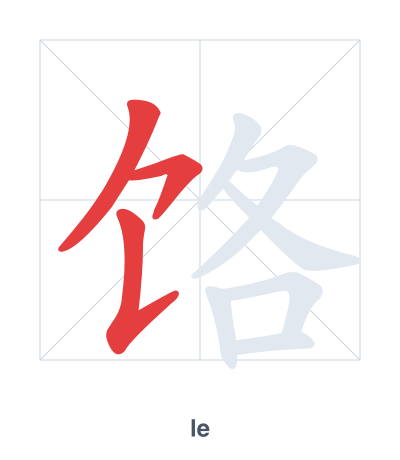
Open Hanzi Writer to see the animated stroke order and practice writing 饹 with real-time feedback.
The character 饹 (le) is written with 9 strokes. Follow the standard Chinese stroke order: top to bottom, left to right, outside before inside. The radical 饣 is one of its key components.
Practice the correct stroke order with the Hanzi Writer app to see animated stroke-by-stroke guidance with real-time feedback.
饹 means Ge (used in the word 'Hele').
饹 is a phono-semantic compound where the radical 饣 (food) indicates its connection to edible items, and the component 各 (gè) provides the approximate pronunciation. It appears primarily in the word 饸饹 (héle), a type of Chinese noodle made from buckwheat or other grains.
💡 Memory Tip: Imagine a bowl of noodles (饣) where each strand is labeled with 各 (gè) to remind you of the phonetic clue for 'le' in 'héle'.
这碗饸饹很好吃。
zhè wǎn hé le hěn hǎo chī
This bowl of hele noodles is delicious.
我想吃一碗饸饹面。
wǒ xiǎng chī yī wǎn hé le miàn
I want to eat a bowl of Hele noodles.
他在厨房压饸饹。
tā zài chú fáng yā hé le
He is making Hele noodles in the kitchen.
Open Hanzi Writer to see the animated stroke order and practice writing 饹 with real-time feedback.
✨ Animated stroke order · Handwriting recognition · HSK-graded practice · Free to use
饹 is a left-right character. The left part 饣 (food radical) indicates it relates to food or eating. The right part 各 (gè) provides the sound 'le' in this compound and also appears in the word 饸饹, where 饹 is always used.