肋 (lē/lèi) means "rib / side of the body" in Chinese. It has 6 strokes with the radical 月.
Rated 3.2/5 in difficulty (challenging).
Appears in 3+ common words including 肋骨 (lèi gǔ), 肋部 (lē bù), 软肋 (ruǎn lèi).
Due to its 6 strokes, Hanzi Writer's error detection shows 肋 requires focused practice — most learners need 10+ attempts for consistent accuracy.
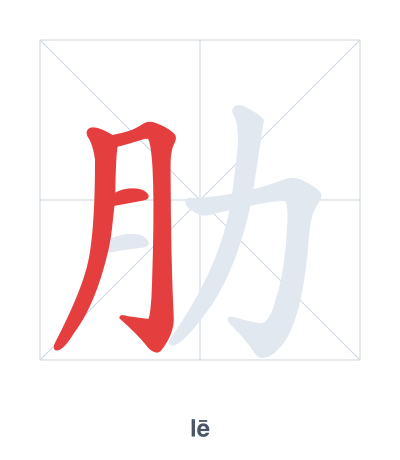
Open Hanzi Writer to see the animated stroke order and practice writing 肋 with real-time feedback.
The character 肋 (lē/lèi) is written with 6 strokes. Follow the standard Chinese stroke order: top to bottom, left to right, outside before inside. The radical 月 is one of its key components.
Practice the correct stroke order with the Hanzi Writer app to see animated stroke-by-stroke guidance with real-time feedback.
肋 means rib / side of the body.
This is a polyphonic character with readings: lē, lèi.
肋 is a compound character combining the radical 月 (flesh/body) with 力 (strength, also serving as a phonetic component). The 月 indicates this relates to the body, while 力 suggests the rib's role in providing structural strength to the torso.
💡 Memory Tip: Imagine a strong person flexing their side, with the ribcage (月) visibly showing the 'power' (力) of each rib.
他的肋骨断了。
tā de lèi gǔ duàn le
His rib is broken.
肋部有点疼。
lē bù yǒu diǎn téng
My side hurts a bit.
这是他的软肋。
zhè shì tā de ruǎn lèi
This is his Achilles' heel.
Open Hanzi Writer to see the animated stroke order and practice writing 肋 with real-time feedback.
✨ Animated stroke order · Handwriting recognition · HSK-graded practice · Free to use
The left component is the radical 月 (flesh/meat), which shows this character relates to the body. The right component is 力 (power/strength), hinting that ribs are strong bones that protect the body's vital organs.