葵 (kuí) means "sunflower / mallow" in Chinese. It has 12 strokes with the radical 艹.
Rated 4.2/5 in difficulty (advanced).
Appears in 3+ common words including 向日葵 (xiàng rì kuí), 葵花籽 (kuí huā zǐ), 葵扇 (kuí shàn).
Due to its 12 strokes, Hanzi Writer's error detection shows 葵 requires focused practice — most learners need 10+ attempts for consistent accuracy.
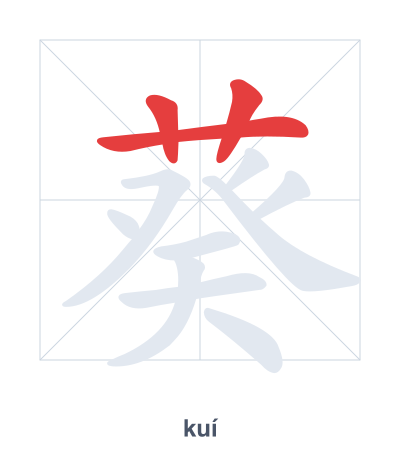
Open Hanzi Writer to see the animated stroke order and practice writing 葵 with real-time feedback.
The character 葵 (kuí) is written with 12 strokes. Follow the standard Chinese stroke order: top to bottom, left to right, outside before inside. The radical 艹 is one of its key components.
Practice the correct stroke order with the Hanzi Writer app to see animated stroke-by-stroke guidance with real-time feedback.
葵 means sunflower / mallow.
葵 is a phono-semantic compound: the top radical 艹 (grass) indicates it is a plant, while the bottom part 癸 (guǐ) provides the pronunciation. This character originally referred to mallow plants, and later came to mean sunflower, which follows the sun's movement.
💡 Memory Tip: Imagine a sunflower with two leaves (艹) and a large clock face (癸) on its stem, always turning to follow the sun's time.
向日葵很漂亮。
xiàng rì kuí hěn piào liàng
Sunflowers are very beautiful.
他在吃葵花籽。
tā zài chī kuí huā zǐ
He is eating sunflower seeds.
奶奶用葵扇。
nǎi nǎi yòng kuí shàn
Grandma uses a palm-leaf fan.
Open Hanzi Writer to see the animated stroke order and practice writing 葵 with real-time feedback.
✨ Animated stroke order · Handwriting recognition · HSK-graded practice · Free to use
葵 is composed of the radical 艹 (grass) on top, which indicates it is a plant, and the phonetic component 癸 below, which hints at its pronunciation kuí. The character means sunflower or mallow, both being plants with broad leaves and flowers.