暌 (kuí) means "separated; apart" in Chinese. It has 13 strokes with the radical 日.
Rated 4.2/5 in difficulty (advanced).
Appears in 3+ common words including 暌违 (kuí wéi), 暌别 (kuí bié), 暌隔 (kuí gé).
Due to its 13 strokes, Hanzi Writer's error detection shows 暌 requires focused practice — most learners need 10+ attempts for consistent accuracy.
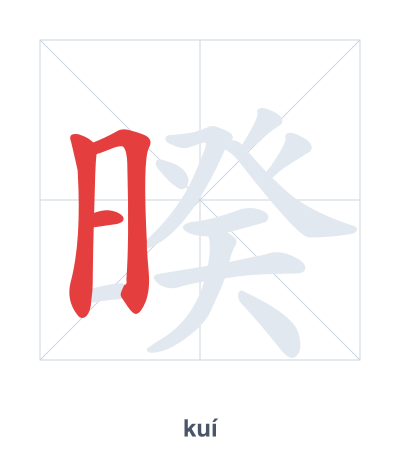
Open Hanzi Writer to see the animated stroke order and practice writing 暌 with real-time feedback.
The character 暌 (kuí) is written with 13 strokes. Follow the standard Chinese stroke order: top to bottom, left to right, outside before inside. The radical 日 is one of its key components.
Practice the correct stroke order with the Hanzi Writer app to see animated stroke-by-stroke guidance with real-time feedback.
暌 means separated; apart.
The character 暌 combines the sun radical 日 (representing time or day) with the phonetic component 癸 (the tenth Heavenly Stem, pronounced guǐ). The sun suggests a passage of days, and this character is used in words like 暌违 meaning 'to be separated for a long time', implying days apart. Its structure visually ties the concept of separation to the sun moving away through time.
💡 Memory Tip: Imagine the sun (日) being sliced in half by a pair of crossed knives (the 癸 component), symbolizing a permanent separation.
我们已经暌违多年。
wǒ men yǐ jīng kuí wéi duō nián
We have been apart for many years.
老友暌别,今日重逢。
lǎo yǒu kuí bié jīn rì chóng féng
Old friends separated for a long time meet again today.
两地暌隔,书信不断。
liǎng dì kuí gé shū xìn bù duàn
Though separated by distance, they kept up a constant correspondence.
Open Hanzi Writer to see the animated stroke order and practice writing 暌 with real-time feedback.
✨ Animated stroke order · Handwriting recognition · HSK-graded practice · Free to use
暌 is composed of the radical 日 (sun) on the left and the phonetic component 癸 (guǐ) on the right. The sun represents time or day, while 癸 gives the sound—together they suggest "apart" as in time separating people. This matches its meaning of being separated or distant.