屯 (tún) means "to station (troops); to store up; village" in Chinese. It has 4 strokes with the radical 屮, and is HSK Level 7.
Rated 2.7/5 in difficulty (moderate).
Harder than 4% of HSK Level 7 characters.
Appears in 3+ common words including 屯兵 (tún bīng), 屯积 (tún jī), 屯子 (tún zi).
Hanzi Writer's stroke validation shows learners typically need 5-8 attempts to write 屯 with correct proportion and order.
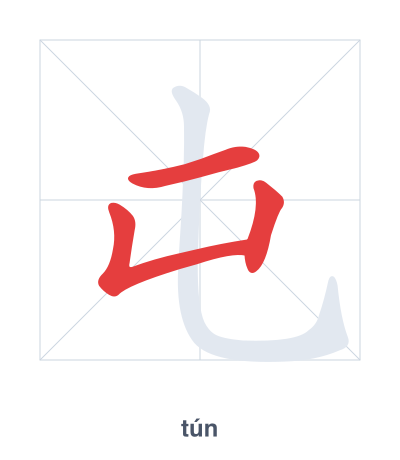
Open Hanzi Writer to see the animated stroke order and practice writing 屯 with real-time feedback.
The character 屯 (tún) is written with 4 strokes. Follow the standard Chinese stroke order: top to bottom, left to right, outside before inside. The radical 屮 is one of its key components.
Practice the correct stroke order with the Hanzi Writer app to see animated stroke-by-stroke guidance with real-time feedback.
屯 means to station (troops); to store up; village.
As an HSK Level 7 character, 屯 is an intermediate-level character.
Originally a pictograph of a sprouting seed with roots, representing something gathering strength underground. The ancient form showed a seedling (屮) with a horizontal line suggesting the ground, conveying the idea of storing up energy or stationing troops in one place.
💡 Memory Tip: Picture a tiny sprout (屮) pushing through the ground (一) to form a village (屯) where soldiers are stationed to store supplies.
军队在山下屯兵。
jūn duì zài shān xià tún bīng
The army is stationed at the foot of the mountain.
不要屯积粮食。
bú yào tún jī liáng shí
Don't hoard grain.
他住在这个屯子。
tā zhù zài zhè ge tún zi
He lives in this village.
Open Hanzi Writer to see the animated stroke order and practice writing 屯 with real-time feedback.
✨ Animated stroke order · Handwriting recognition · HSK-graded practice · Free to use
屯 is built from the radical 屮, which means a sprout or plant. The horizontal stroke on top may represent ground or a covering, and the whole shape suggests something being stored or gathered, like troops stationed in one place or goods piled up.