Hanzi Writer

How to Write 哐 (kuāng) — Meaning “Clang / Bang”

kuāng 9 strokes Radical: 口

哐 (kuāng) means "Clang / Bang" in Chinese. It has 9 strokes with the radical 口.

Rated 4/5 in difficulty (challenging).

Appears in 3+ common words including 哐当 (kuāng dāng), 哐哐 (kuāng kuāng), 哐 (kuāng).

Due to its 9 strokes, Hanzi Writer's error detection shows 哐 requires focused practice — most learners need 10+ attempts for consistent accuracy.
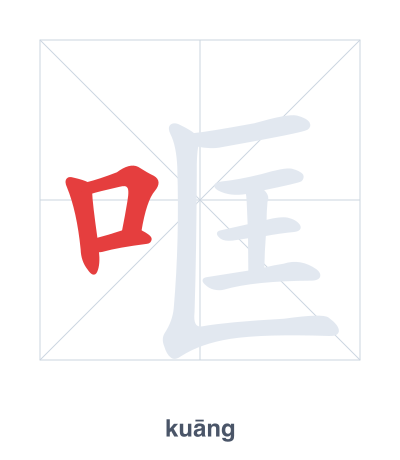
Stroke order practice for 哐 - kuāng

Practice Writing 哐 (kuāng)

Open Hanzi Writer to see the animated stroke order and practice writing 哐 with real-time feedback.

The character (kuāng) is written with 9 strokes. Follow the standard Chinese stroke order: top to bottom, left to right, outside before inside. The radical is one of its key components.

Practice the correct stroke order with the Hanzi Writer app to see animated stroke-by-stroke guidance with real-time feedback.

means Clang / Bang.

Character
Pinyinkuāng (kuang)
MeaningClang / Bang
Strokes9
Radical
Difficulty4/5

哐 is a semantic-phonetic compound. The radical 口 (mouth) indicates it represents a sound, while 匡 (kuāng) provides the pronunciation. Together, they form an onomatopoeic character mimicking a loud metallic clang or bang.

💡 Memory Tip: Picture a king (王) trapped in a box (匚) banging his fists against the walls, making a loud 'KUANG!' sound, with the mouth (口) shouting the noise.

kuāng dāng
Clang / Thud
kuāng kuāng
Clanging / Banging
kuāng
Clang / Bang

门哐当一声关上了。

mén kuāng dāng yī shēng guān shàng le

The door closed with a loud bang.

他哐哐地敲门。

tā kuāng kuāng dì qiāo mén

He banged loudly on the door.

哐的一声响。

kuāng de yī shēng xiǎng

With a loud bang.

Character Pinyin Strokes Radical
(current) kuāng 9
jūn 7
lìn 7
tūn 7
Stroke order practice for 哐 - kuāng

Practice Writing 哐 (kuāng)

Open Hanzi Writer to see the animated stroke order and practice writing 哐 with real-time feedback.

✨ Animated stroke order · Handwriting recognition · HSK-graded practice · Free to use

Frequently Asked Questions about 哐

哐 is a phono-semantic compound. The left part 口 (mouth radical) indicates a sound, and the right part 匡 (kuāng) provides the pronunciation. Together they form a character that represents the sound of a clang or bang.

Characters with Radical 口

Other 9-Stroke Characters