蚪 (dǒu) means "tadpole" in Chinese. It has 10 strokes with the radical 虫.
Rated 4.2/5 in difficulty (advanced).
Appears in 3+ common words including 蝌蚪 (kē dǒu), 蝌蚪文 (kē dǒu wén), 小蝌蚪 (xiǎo kē dǒu).
Due to its 10 strokes, Hanzi Writer's error detection shows 蚪 requires focused practice — most learners need 10+ attempts for consistent accuracy.
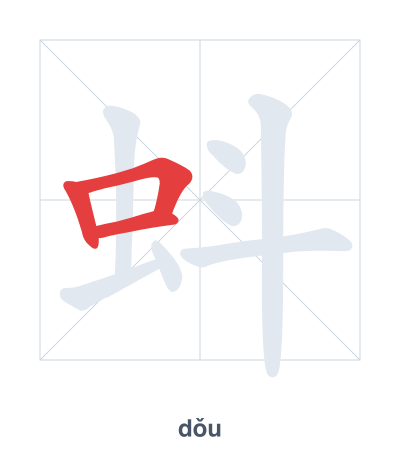
Open Hanzi Writer to see the animated stroke order and practice writing 蚪 with real-time feedback.
The character 蚪 (dǒu) is written with 10 strokes. Follow the standard Chinese stroke order: top to bottom, left to right, outside before inside. The radical 虫 is one of its key components.
Practice the correct stroke order with the Hanzi Writer app to see animated stroke-by-stroke guidance with real-time feedback.
蚪 means tadpole.
This character is a phono-semantic compound: the radical 虫 (insect/creature) indicates a small aquatic animal, while 斗 (dǒu, dipper) provides the pronunciation and visually suggests a tadpole's round head and tapering tail resembling a ladle.
💡 Memory Tip: Picture a tiny insect-like creature (虫) with a head shaped like a measuring dipper (斗) wriggling its tail—that's a tadpole.
水里有很多小蝌蚪。
shuǐ lǐ yǒu hěn duō xiǎo kē dǒu
There are many small tadpoles in the water.
这种文字叫蝌蚪文。
zhè zhǒng wén zì jiào kē dǒu wén
This script is called Tadpole script.
小蝌蚪在找妈妈。
xiǎo kē dǒu zài zhǎo mā mā
The small tadpole is looking for its mother.
Open Hanzi Writer to see the animated stroke order and practice writing 蚪 with real-time feedback.
✨ Animated stroke order · Handwriting recognition · HSK-graded practice · Free to use
蚪 is made of 虫 (insect/worm radical) on the left and 斗 (dǒu) on the right. The radical 虫 indicates the character relates to small creatures, which fits the meaning "tadpole." The right part 斗 provides the pronunciation dǒu, but does not directly contribute to the meaning.